


Questions to Ask Influencers Before You Work With Them
22 June 2026

Written By Katja Orel
Lead Editor, UGC Marketing

Fact Checked By Sebastian Novin
Co-Founder & COO, Influee
61% of marketers say finding the right influencer is one of the hardest parts of running a campaign. The problem isn't finding influencers with a big following. It's knowing whether they fit the campaign before you've committed budget.
Most brands learn this the hard way: off-brief content, engagement that doesn't convert, and usage rights disputes after the content is already live.
The questions below are what you ask when you're vetting by hand, the way most brands still run influencer outreach today. They're also a symptom of a broken workflow, and the last section covers why most of that work disappears on the right platform.

Questions to ask about their audience

Audience quality is the first thing to check and the easiest to fake. Five questions surface most of what you need.
Who makes up your audience? Ask for the age, location, and gender split straight from their analytics, not a description in their own words. A creator selling to a US brand whose audience sits 70% outside the US is the wrong fit, however good the content looks.
What percentage of your followers are in [your target market]? A strong overall audience means nothing if your buyers aren't in it. Get the exact figure for the country or region you sell into, not a vague "mostly your area."
What's your average engagement rate over the last 90 days? Below 1% on Instagram or 3% on TikTok is a red flag regardless of follower count. Ask for the 90-day window, not a single hero post they can cherry-pick.
Have you had any sudden follower spikes? A jump with no viral post behind it is the clearest sign of bought followers. It's one of the fake influencers signals worth cross-checking, alongside generic comments and engagement that doesn't match reach.
What content format gets the best response? Reels, Stories, static posts, and TikToks convert differently per audience. An influencer whose audience saves long-form Reels but scrolls past static posts should be briefed for Reels. Knowing their strongest format upfront saves a round of revisions later.

Micro & nano influencers starting at A$60

5,000+ Vetted Creators in Australia
Questions to ask about past brand work
Past performance is the best predictor of future performance. An influencer who can't show data from previous campaigns is a risk, not a bargain.
Which brands have you worked with in the last 6 months? Recent collaborations tell you their niche, their rate bracket, and whether they've already promoted a direct competitor to the same audience.
Do you have any active exclusivity agreements? A category exclusivity deal with another brand can block your campaign entirely. Better to know before you negotiate than after you've agreed a rate.
Can you share performance data from a recent sponsored post? Reach, saves, clicks, or sales let you judge their work against your own influencer marketing ROI targets. An influencer who tracks results will have these ready without stalling.

Have you ever declined a brand collaboration, and why? This one is underrated. An influencer who turns down misaligned brands protects their audience's trust, which is exactly what makes their recommendation worth paying for.
Questions to ask about deliverables and rights
Usage rights disputes are one of the most common friction points in influencer campaigns. Clarity upfront prevents an expensive argument once the content is live. Get the answers below in writing, in the influencer brief, not a verbal deal.
What's included in your rate? Get the exact deliverables in writing: how many posts, how many Stories, and how many revisions before extra fees kick in. "One post" and "one post plus three Stories and two revisions" are very different deals at the same headline price.
Who owns the content after it's published? Many influencers keep ownership by default and license you a single use. If you want to repost it or run it longer, that has to be agreed now, not assumed.
Are you willing to grant usage rights for paid ads? Paid-ad rights, sometimes called influencer whitelisting, let you run the content from the influencer's own handle. Agree it before the brief goes out, because asking post-production usually costs extra or gets refused.
What's your turnaround time from brief to first draft? A clear timeline keeps the campaign on schedule and flags over-booked influencers early, before they miss your launch date.
Why Influee makes most of these questions unnecessary
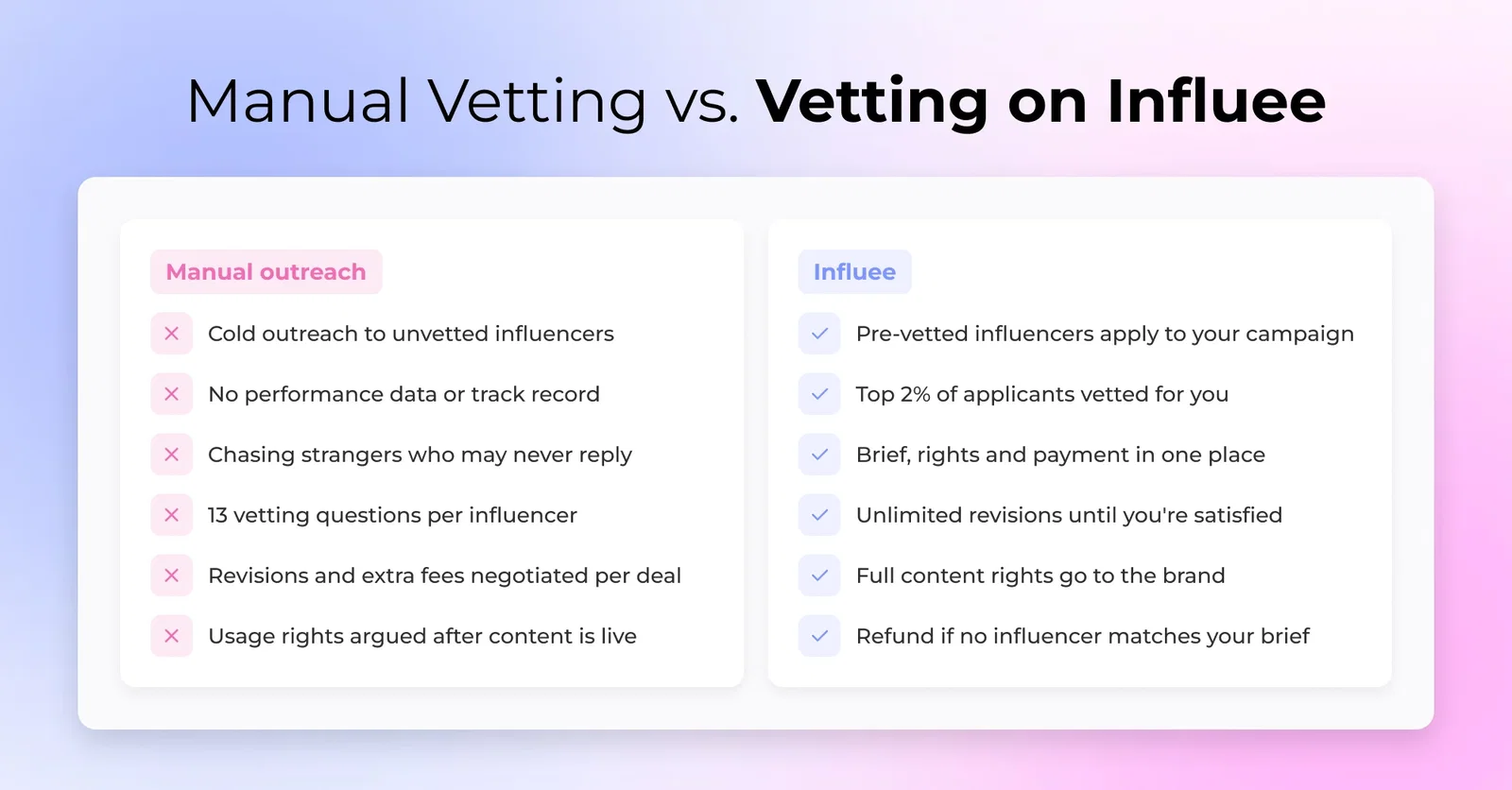
Most of these questions exist for one reason: brands are doing cold outreach to unvetted influencers, with no data, no track record, and no agreed workflow. Influee flips the model.
Brands post a campaign brief on the influencer marketing platform, and pre-vetted nano and micro influencers apply to work on it. You pick from people who already match your audience and category, instead of chasing strangers who may never reply.
- Influencers apply to your campaign, so you stop chasing and start choosing.
- The top 2% of applicants are vetted on the platform before they ever reach you.
- Brief, revisions, approvals, usage rights, and payments all live in one place.
- Revisions are unlimited until you're satisfied with the content.
- Full content rights go to the brand, so there's no rights conversation to have later.
The questions above are still worth knowing if you're doing manual outreach. With Influee, the answers are built into the process before the campaign starts. And if no influencer on the platform matches your brief, the campaign is refunded under the money-back guarantee.
Micro & nano influencers starting at A$60
5,000+ Vetted Creators in Australia
FAQ
Are there free influencer analytics tools?

Free influencer analytics tools exist, but most put the data that matters for vetting, like full audience demographics and follower authenticity, behind a paid tier. For a single campaign, asking the influencer for screenshots of their own platform insights is usually faster than piecing together free tools.
How do I know if an influencer is right for my brand?
An influencer is right for your brand when the overlap between their audience and your actual buyers is high. Start there: a creator with great content but the wrong audience location will underperform one with rougher content and the right buyers. Niche fit and clean usage rights are the tie-breakers once that overlap checks out.
What is the difference between vetting an influencer yourself vs using a platform?
Vetting yourself costs hours per influencer and leaves you trusting self-reported numbers from people you've never worked with. A platform shifts that cost upfront: Influee screens influencers before they reach you, so the data you'd normally have to chase and verify yourself is already confirmed.
How do AI and automation help with influencer vetting?
AI and automation speed up vetting by scoring large numbers of influencers at once and surfacing the few that fit a brief, instead of making you screen each profile by hand. They narrow the field; the final call on brand fit and tone still belongs to a person, because that judgment doesn't reduce to a single metric.
Table of Contents

Questions to ask about their audience
Questions to ask about past brand work
Questions to ask about deliverables and rights
Why Influee makes most of these questions unnecessary
FAQ

Work with influencers from Australia
Australia

Lucy

Gold Coast

Annalise
Nirimba

Madalyn
Melbourne

Kortney
Mackay