


UGC vs Influencers: Key Differences and When to Use Each
17 March 2026

Written By Katja Orel
Lead Editor, UGC Marketing

Edited By Léo Blanc
Head of SEO

Fact Checked By Sebastian Novin
Co-Founder & COO, Influee
79% of people say user-generated content impacts their buying decisions. Influencer marketing is a $21 billion industry. Both strategies produce social content for brands, but they work completely differently.
One is hired for the content itself. The other is hired for their audience. Knowing which you need, and when to combine both, is one of the most consequential decisions in your content mix.
This guide breaks down the real differences between UGC creators and influencers, the pros and cons of each, and exactly when to use one, the other, or both.

What Is a UGC Creator?
A UGC creator produces authentic-looking videos, photos, and testimonials that brands use in their ads, on product pages, and in email campaigns. They don't post on their own social media. The content goes straight to the brand.
Think of it as a spectrum: UGC creator → content creator → influencer. A UGC creator sits at one end, focused purely on the deliverable. They don't need a following. They need to be good on camera and understand what makes an ad convert. Most are niche-specific (think beauty, fitness, fashion, home), so content fits your audience from the first video.
The most common types of UGC content are:
- Unboxing videos (a strong unboxing video ad angle on its own)
- Testimonial and review videos
- Tutorial reels and how-to-use videos
The brand gets full ownership of the content on delivery. That means you can run it as a paid ad, put it on your product page, drop it into an email sequence, or repurpose it across channels. No extra licensing, no usage rights negotiation.
A strong piece of UGC feels like it's coming from a real customer. That's why it works: UGC boosts e-commerce conversion rates by 161% when added to product pages.
Side-by-side of a UGC creator filming a product review and the final ad running on a phone screen

What Is an Influencer?
An influencer is someone with an established audience on Instagram, TikTok, or YouTube who promotes products to their followers. The value is the audience they've built and the trust that comes with it.
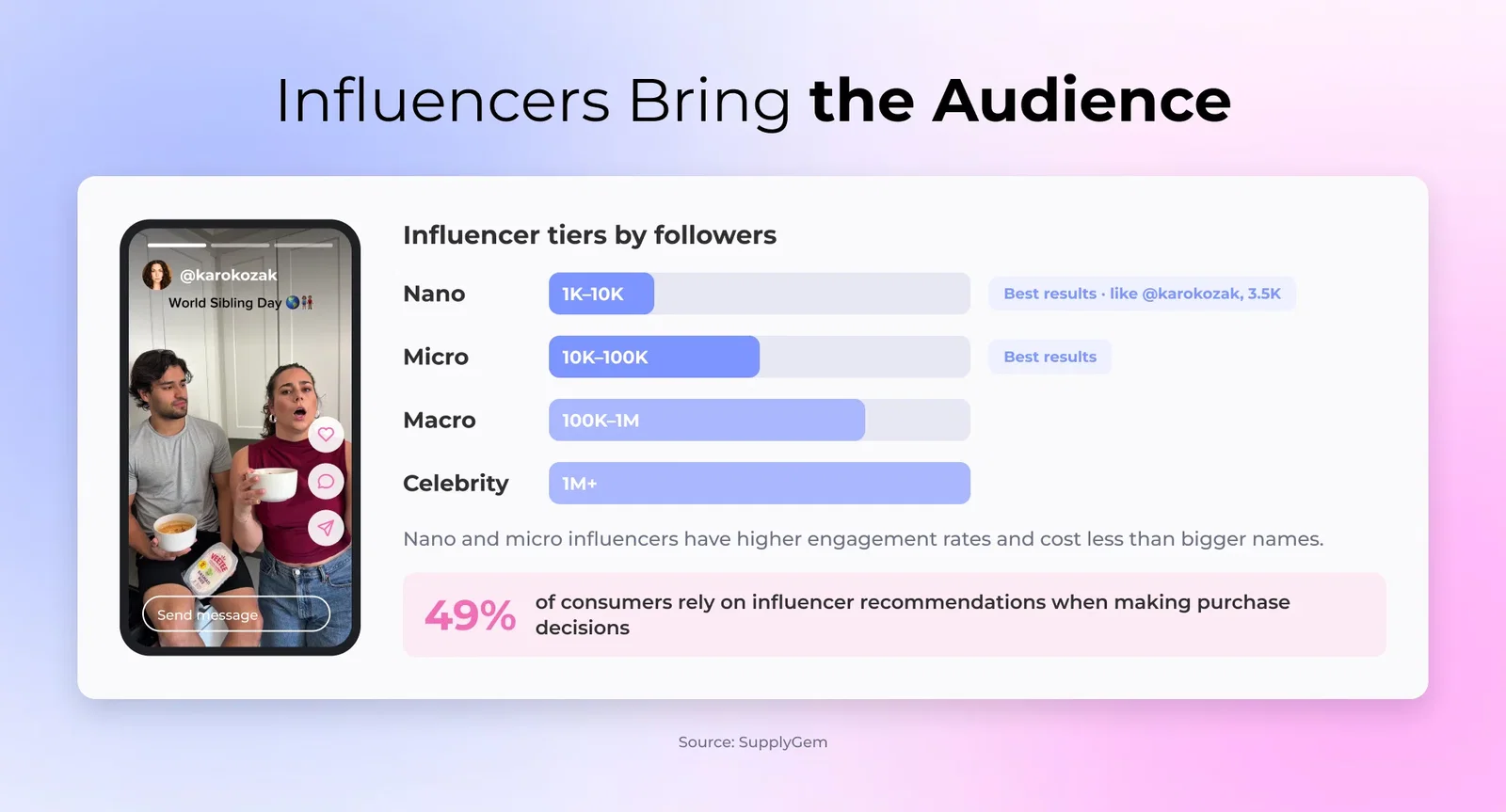
Influencers are typically categorized by follower count: the nano influencer tier (1K–10K), the micro influencer tier (10K–100K), macro (100K–1M), and celebrity (1M+). For most brands, nano and micro influencers deliver the best results. They have higher engagement rates and cost less than bigger names.
Compensation depends on the influencer's reach, engagement rate, and niche. Content usage rights are negotiated separately, which means if you want to run their content as a paid ad, that's an extra conversation (and usually an extra cost).
The real strength of influencers is distribution. When an influencer posts about your product, their followers see it organically. That kind of audience trust is hard to replicate with brand-owned content alone.
UGC vs Influencers: The Key Differences
This is the core comparison. Before deciding which approach fits your campaign, understand how they differ across the factors that actually matter.
UGC Creator | Influencer | |
|---|---|---|
Posts to own audience | No. Content goes to brand channels | Yes. Posts to own followers |
Brand owns content | Yes. Full ownership on delivery | Negotiated. Usage rights cost extra |
What you're paying for | Content quality | Reach + content |
Best for | Paid ads, product pages, email | Awareness, trust, discovery |
Fake follower risk | None | Yes. Vetting required |
Pricing model | Per video or deliverable | Per post, tier, or follower count |
UGC creators give you content assets. Influencers give you content plus distribution. The right choice depends on whether you need something to run in your own channels, or something that reaches an audience you don't have yet.
Pros and Cons of UGC Creators
Pros:
- Full content ownership. You get the files, you own the rights. Run them wherever you want, for as long as you want.
- No fake follower risk. You're paying for content, not an audience. Follower counts are irrelevant.
- Cost-effective at scale. UGC content typically costs less per asset than influencer posts, especially when you need volume for ad creative testing.
- Fast turnaround. Brief a creator, get content back in days. No scheduling around their content calendar.
- Works across channels. The same video can run as a Meta ad, sit on a product page, go into email, and feed your organic social.
- Risk-free on Influee. Revisions are unlimited, and if you can't find the right creator for your project, you get your money back.
Cons:
- No organic reach. UGC creators don't post to their own audience. You need your own distribution: paid ads, email, your social channels.
- No audience trust signal. The content is great, but there's no influencer name or face that followers already trust attached to it.
Pros and Cons of Influencers
Pros:
- Built-in audience. An influencer post reaches thousands (or millions) of people who already follow and trust them.
- Niche authority. The right influencer carries weight in their community. A fitness influencer recommending your supplement has more credibility than a generic ad.
- Organic reach. Content shows up in feeds without you spending on distribution.
- Virality potential. An influencer post can blow up. Reels, TikToks, and Stories get shared, stitched, and reposted.
Cons:
- Higher cost per piece. Especially as you move up from nano to micro to macro tier. Instagram influencer pricing varies widely.
- Fake follower risk. Not every influencer's audience is real. Vetting is essential, and even then, inflated engagement is common. Learn how to spot fake influencers.
- Content rights negotiation. Want to run their post as a paid ad? That's a separate usage rights conversation, often with extra fees.
- Less control. Influencers have their own voice and style. The final content might not match your brand guidelines exactly.
When to Use a UGC Creator
UGC creators are the right call when your goal is content production, not distribution.
Paid social creative testing. You're running Meta or TikTok ads and need 10–20 creative variations to test hooks, angles, and formats. UGC creators can produce this volume fast, and you own every piece. This is the single most common use case.

Product page content. Testimonial videos, review clips, and demo content all perform better on product pages than polished brand photography.
Email campaigns. UGC in email feels personal. A short testimonial video or photo review in a product launch email outperforms stock imagery every time.
Launching in a new market. Working with local UGC creators who know the language, culture, and what resonates in their market is the fastest way to get relevant content without building a local team.
Scaling content on a budget. When you need volume for A/B testing, seasonal campaigns, or multi-market rollouts, UGC creators deliver more content per dollar than any other approach.

UGC videos starting at A$60

5,000+ Vetted Creators in Australia
When to Use an Influencer
Influencers are the right call when your goal is reach.
Brand awareness in a new niche. If nobody in the fitness community knows your brand, partnering with a trusted fitness micro influencer puts you in front of an audience that already cares about your category.
Product launch reach. 49% of consumers rely on influencer recommendations when making purchase decisions. An influencer teasing your product with "sneak peeks" or "first looks" creates anticipation and instant visibility.
Community trust building. Influencer endorsements carry social proof that brand content can't replicate. When a creator's followers see them genuinely using your product, it builds credibility faster than any ad.
Affiliate and commission campaigns. Influencers with engaged audiences can drive direct sales through personalized discount codes and tracked links. This makes performance measurable and ties influencer marketing budget directly to revenue.

Ongoing brand presence. Long-term influencer partnerships keep your brand visible in a niche community. Regular posts from the same creator build familiarity and trust over time.
When to Use Both
Most brands treat UGC and influencer marketing as either/or. They work better as two parts of the same funnel.
Top of funnel: influencers for reach. Partner with micro and nano influencers to get your product in front of new audiences. Their posts generate awareness and social proof organically.
Mid-funnel: whitelist influencer content for paid social. Take the best-performing influencer content and run it as a paid ad through Spark Ads (TikTok) or whitelisting (Meta). You get the authentic feel of an influencer post with the targeting precision of paid media. The ad runs from the influencer's account, so it keeps the social proof (comments, likes, shares) intact.
Bottom of funnel: UGC for conversion. Use UGC creator content on product pages, in retargeting ads, and in email sequences. This is the content that pushes people from "interested" to "purchased."
The brands that combine both approaches build a full-funnel content strategy: influencers bring people in, UGC closes the deal.
Influee offers both UGC creation and an influencer marketing platform, so you can run this entire strategy from one place.
Access vetted influencers across 30+ countries
Nano and micro influencers in Australia
UGC vs Influencers: Use-Case Breakdown
How UGC creators and influencers stack up across the most common marketing goals.
Growing a New Brand
Nobody knows you yet, and without reviews or customer proof, people don't trust you.
UGC creators can produce relatable UGC video content, photos, and testimonials that make your brand feel real and credible from day one. No need to wait for actual customers to start generating social proof.
Influencers introduce your brand to their followers. They already have a dedicated, engaged audience. A few well-placed posts from the right creators can generate more initial awareness than months of brand-owned content.
For this goal, use both. UGC for your ad creative and product pages. Influencers for awareness.
Launching a New Product
Create buzz with testimonials, unboxing videos, and demo content. UGC creators can produce how-to videos, unboxing clips, and relatable testimonials that showcase your product and build excitement.
Influencers create instant visibility. A teaser campaign on an influencer's channel builds anticipation fast, especially when paired with a trackable discount code.
For this goal, use both. UGC for ad creative and product pages. Influencers for launch day reach.
Expanding to a New Market
Entering a new market means dealing with unfamiliar language, culture, and audience expectations.
Local UGC creators know what resonates. Working with a platform that has international creators means you're producing market-specific content from the start, no guesswork required.
Once you're established, bring in local influencers to extend your reach in that market and build community trust.
For this goal, start with UGC creators, then add influencers.
Getting More Sales
UGC content builds trust and drives conversions. Viewers feel like they're getting a recommendation from a real person, not an ad.
Influencers drive direct sales through personalized discount codes and tracked links. Build a retargeting funnel using influencer-generated content to target users who engaged with the post but didn't purchase.
For this goal, use both. UGC for ad creative and retargeting. Influencers for top-of-funnel traffic with trackable codes.
Growing Social Media Organically
Repurpose UGC content across your channels: paid campaigns, website, email, and organic social. UGC drives 28% higher engagement than traditional branded content and gets shared 50% more often.
For influencer content, share their posts on your Stories, repost to your feed (with credit), or request the original files for your brand's account. For paid ads, you'll need content usage rights, either through a paid partnership or whitelisting on Meta.
For this goal, use both. UGC for volume and repurposing. Influencer content for organic sharing and whitelisted ads.
Growing an Established Brand
Staying relevant means fresh content, consistently. Long-term UGC creator partnerships deliver a steady stream of authentic content that shows your product in real-life situations.
Influencer collaborations reinforce your brand's identity and keep you visible in niche communities. Regular posts from trusted creators remind loyal customers why they chose you.
For this goal, use both. UGC for ongoing content production. Influencers for brand presence and community trust.
UGC videos starting at A$60
5,000+ Vetted Creators in Australia
FAQ
What is the difference between a UGC creator and an influencer?

A UGC creator produces content for the brand's own channels: ads, product pages, email. They don't post on their own social media. An influencer posts to their own audience, and the value is in their reach and follower trust, not only the content itself.
Are UGC creators cheaper than influencers?
UGC creators are typically more cost-effective because you're paying for content, not audience access. Pricing is per deliverable (per video, per photo), while influencer pricing scales with follower count, engagement rate, and usage rights.
Can a UGC creator also be an influencer?
A UGC creator can also be an influencer if they have their own following, but the two roles serve different purposes. When someone works as a UGC creator, they're producing content for the brand to use. When they work as an influencer, they're posting to their own audience. Some people do both. The key is knowing which role you're hiring them for.
Which is better for paid ads, UGC or influencer content?
UGC content is better for paid ads in most cases. It's designed to feel authentic in a feed, the brand owns it outright, and it's easy to produce multiple variations for testing against your influencer marketing KPIs. Influencer content can work in paid ads too, especially through whitelisting or Spark Ads, but it requires separate usage rights negotiation.
Do I need both UGC creators and influencers?
Most brands benefit from using both UGC creators and influencers. Influencers bring awareness and organic reach at the top of the funnel. UGC content drives conversions at the bottom, in ads, on product pages, and in email. The brands seeing the best results run both strategies together from a single platform that supports both.
Table of Contents

What Is a UGC Creator?
What Is an Influencer?
UGC vs Influencers: The Key Differences
Pros and Cons of UGC Creators
Pros and Cons of Influencers
When to Use a UGC Creator
When to Use an Influencer
When to Use Both
UGC vs Influencers: Use-Case Breakdown
FAQ

Work with UGC creators from Australia
Australia

Genevieve

Shoalhaven

Sandy
Sydney

Holly
Perth

Brittney
Brisbane