


User Generated Content Strategy: How to Build One That Works
June 30, 2026

Written By Katja Orel
Lead Editor, UGC Marketing

Fact Checked By Sebastian Novin
Co-Founder & COO, Influee
Most brands treat user generated content as a happy accident. A customer posts something good, the brand reposts it, everyone moves on. This post assumes you already know what UGC is and skips straight to making it work.
The brands getting real returns treat UGC as a system. A user generated content strategy is how you move from reactive to proactive: briefing creators, deploying their content across paid channels, and building a library that compounds over time.
This guide makes the argument most strategy posts skip. Start with paid, not organic. Here's how to build one that moves CPC, CTR, and ROAS.

What is a user generated content strategy?

A user generated content strategy is a systematic approach to collecting, managing, and deploying user-generated content across your marketing channels. It has four things ad hoc UGC doesn't: defined goals, a repeatable collection process, usage rights agreed upfront, and a way to measure what each asset returns.
Here's the line that separates the two. Reposting a happy customer is a tactic. Knowing you need 15 video ads for next quarter's Meta campaign, briefing creators to produce them, and tracking which hooks drive the lowest CPC is a strategy.
The biggest decision inside any UGC strategy is where you start. Organic-first brands wait for customers to post, then collect and repurpose what shows up. Paid-first brands brief creators for ad formats from day one, then let organic follow.
The difference shows up in your numbers. An organic-first brand can spend months building a hashtag gallery and still have nothing it can legally run as an ad. A paid-first brand has 10 briefed, rights-cleared videos in the feed within two weeks, with data on which ones convert.
Those two paths produce completely different outcomes for most brands. The rest of this guide explains why paid-first wins, and how to build one.
Why paid-first beats organic-first for most brands

Most brands build their UGC strategy in the wrong order. They chase organic posts first, collect what trickles in, and bolt paid on later when they need ad creative.
Flip it. Brief creators for paid ads first, and organic becomes the easy part.
The performance gap is the reason. Briefed UGC built for paid ads gets 4x higher CTR and 50% lower CPC than standard brand creative. You won't get that from a customer photo you reposted on a Tuesday.
Four reasons paid-first works:
Organic UGC is unpredictable. You can't brief a customer the way you brief a creator. You get what they happen to post, when they happen to post it, in whatever format they choose.
Briefed content is built to convert. A creator briefed for a 3-second hook and a clear CTA delivers an asset designed for the feed. The strongest UGC ads are built this way, and that's where the higher CTR comes from.
Rights are built in. Brief creators through Influee and full content rights come with the deliverable, paid ads included. No chasing permissions, no legal grey area, no DMing a customer to ask if you can run their post as an ad.
Volume is controllable. Need 10 videos for a campaign? Brief 10 creators. Organic doesn't scale on demand: it shows up whenever customers feel like posting, not when your launch date needs it.
Organic UGC still earns its place. It builds social proof, community, and brand sentiment over time. But it follows a strong paid strategy. It doesn't replace one. The best creative usually starts as a briefed ad and earns a second life as an organic post.

UGC videos starting at $86

10,000+ Vetted Creators in Canada
The five components of a user generated content strategy

Every UGC strategy worth the name has five moving parts. Get one wrong and the whole thing leaks.
1. Goals. Decide what the UGC is for before you brief anyone. Paid ads, organic social, product pages, and email each need different formats and lengths. A 9:16 hook-driven video for TikTok ads is not the same asset as a clean product shot for a product page.
Write the goal down as a number. "20 video ads for Q3 testing" beats "more content."
2. Collection. For paid, you brief creators on a UGC platform that handles sourcing, contracts, and rights in one place. For organic social proof, you run hashtag or review campaigns that invite customers to post.
Keep the two streams separate. Briefed creator content feeds your ads. Customer posts feed your social proof. Different inputs, different jobs.
3. Briefing. This is where most strategies are won or lost. A good brief specifies the product focus, the key message, the format, the tone, and the usage rights upfront.
Don't write "make a fun video about our product." A brief that produces ready-to-run content covers six lines: the product and one key feature, the audience, the hook for the first 3 seconds, the must-say message, the format (unboxing, testimonial, "3 reasons"), and the rights. Hand a creator those six lines and you get an asset you can run, not a draft you have to fix. A tight UGC brief template does this work for you.
4. Rights. Specify the channels, the duration, and whether you can run the content as a paid ad, agreed before briefing, never after. Chasing rights after the fact is how brands end up with content they love and can't legally use.
The fix is simple. Settle UGC usage rights at the brief stage. With Influee, those rights are included by default with every piece of content you receive.
5. Measurement. Track CTR and ROAS for paid, engagement rate and reach for organic. Without measurement you can't tell which creator, hook, or format earned its budget, which means you can't brief better next time.
How to build a user generated content strategy step by step

Here's the paid-first framework, start to finish.
1. Define the goal. Pick one primary outcome: paid performance, organic social proof, or both. Most ecommerce brands should start with paid performance, because that's where UGC pays for itself fastest.
2. Start with paid. Brief creators for specific ad formats. Hook in the first 3 seconds, product in frame early, one clear CTA. Order 5 to 10 variations so you have something to test, not one precious hero video.
3. Secure rights upfront. Specify paid social channels in the brief before any creator starts, Meta and TikTok at minimum. This is a one-line addition to the brief that saves a month of back-and-forth later.
4. Test at scale. Because each UGC video costs a fraction of produced creative, you can run multiple hooks and formats at once instead of betting everything on one. Split a small test budget across 5 creatives (say €20 a day each), give them 3 to 4 days to gather signal, then move spend to the two with the lowest CPC. That kind of parallel testing isn't realistic when a single asset costs thousands to produce.
5. Measure and iterate. Track CTR and conversion per creative, not per campaign. Tag every creative so you can read it later: name the ad by creator and hook in Meta Ads Manager (creatorA_problemhook_v1) and give each one a unique UTM or promo code. When the report comes back, you'll know which creator and which hook earned the conversion. Feed the winners into your next round of UGC ideas.
6. Let organic follow. Top-performing paid UGC usually works as organic content too. Repurpose the winners to your feed, your product pages, and your email. One asset, four channels.

That last step is the compounding part. A creator video you briefed for a Meta ad can run as a Reel, sit on the product page, and anchor an email, all from one brief.
UGC videos starting at $86
10,000+ Vetted Creators in Canada
Real brand user generated content strategy examples

Four brands, four different UGC strategies. Each one shows what a clear goal plus a collection system actually produces.
GoPro: the content library play. GoPro's entire marketing engine runs on customer footage. More than 50% of its video content and 80% of its social photos are UGC-sourced. Its Million Dollar Challenge pulls in roughly 43,000 submissions a year from 170 countries, and those clips fuel the next 12 months of ads, social posts, and in-store screens. The lesson: a collection system that runs year-round builds a library that compounds.
ASOS: product-page social proof. ASOS built #AsSeenOnMe, a gallery of customer photos that now holds over a million images. Putting real customers in real outfits on the site helped grow active customers by 25%. For an ecommerce UGC strategy, this is the organic side done right. Shoppers see the product on bodies like theirs before they buy.
Airbnb: UGC as paid creative. Airbnb's "Made Possible by Hosts" campaign swapped scripted commercials for real guest footage. The shift cut production costs by 60% and, in A/B testing, drove engagement at triple the rate of scripted ads. Real guest footage cost less to make and outperformed the polished version.
Dr. Squatch: briefed creator content at scale. Dr. Squatch is the paid-first model in its purest form. It runs over 600 active Meta ads, most of them UGC-style creator videos, and pulls around 15% of new customers from TikTok alone. This is what "brief creators, deploy in ads, scale the winners" looks like at full size.
Skew your own examples toward whichever model fits your goal: library-building like GoPro, product-page proof like ASOS, or paid creative volume like Dr. Squatch.
How to measure your user generated content strategy
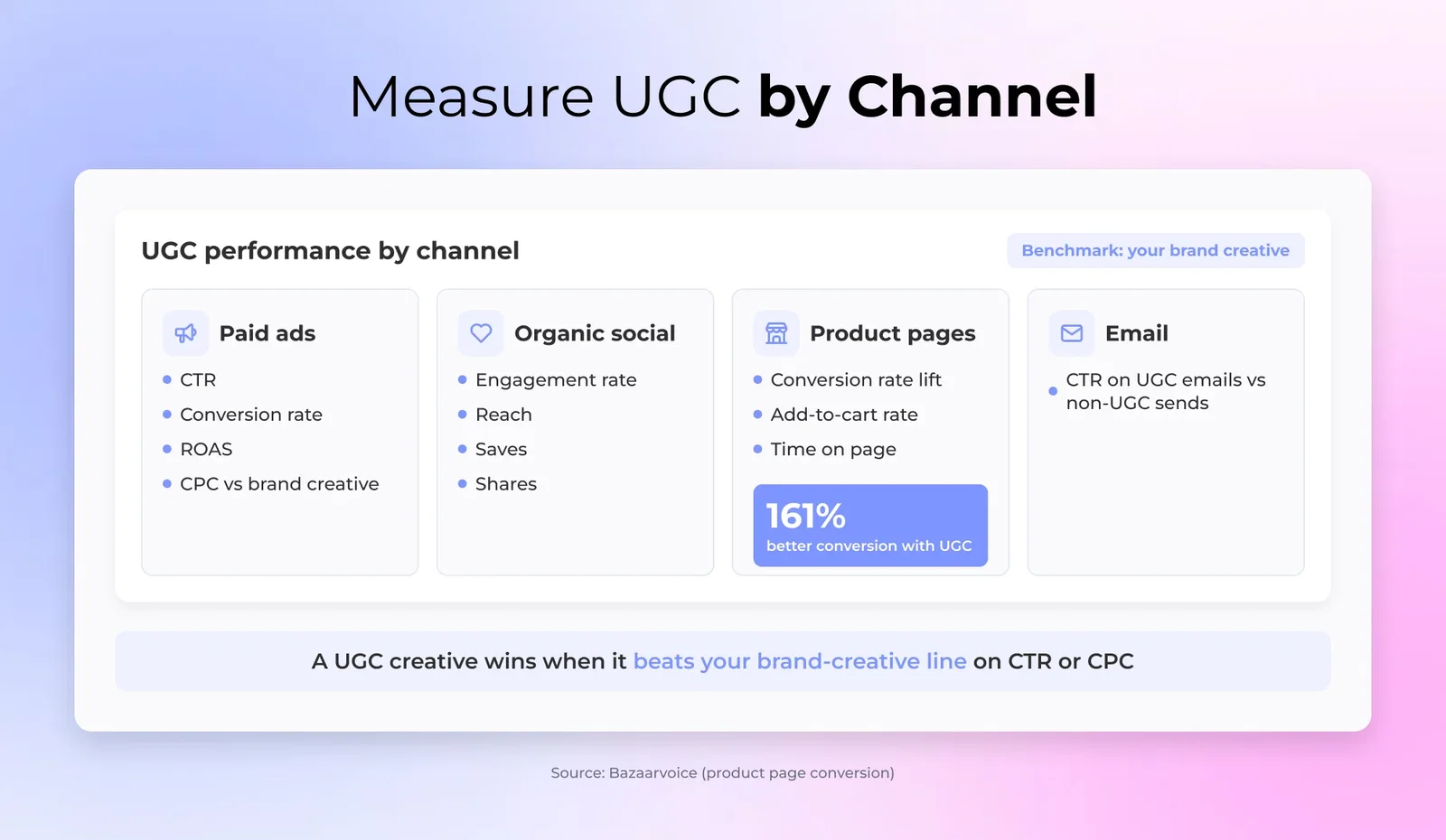
You can't improve a UGC strategy you're not measuring. Track different metrics for each channel, because a great ad and a great product-page asset succeed in different ways.
Paid ads: CTR, conversion rate, ROAS, and CPC against your brand-creative benchmark. The benchmark comparison is the one most brands skip, and it's the one that proves UGC is worth the spend.
Organic social: engagement rate, reach, saves, and shares. Saves and shares matter more than likes here, because they signal content people want to keep or pass on.
Product pages: conversion rate lift, add-to-cart rate, and time on page. This is where ecommerce UGC pays for itself. Product pages with UGC convert 161% better than pages without it.
Email: CTR on UGC emails versus non-UGC sends. A single creator video in a campaign email usually beats a polished product render on click-through.

Set the benchmark first. Pull your current CTR, CPC, and conversion rate for brand creative, then measure every UGC asset against it. A UGC creative "wins" when it beats that brand-creative line on CTR or CPC, not when it simply gets engagement. Track per creative, not per campaign, so you know exactly which hook and which creator to brief again. Pricing matters here too. When you know your UGC price per asset and the ROAS each one returns, the math for scaling gets simple: keep briefing what clears the benchmark, retire what doesn't.
Where does this fall apart? If you're running fewer than 5 creatives at a time, per-creative measurement won't tell you much. The sample is too small to call a winner. UGC measurement rewards volume. If your budget only supports one or two videos a quarter, build organic social proof first and scale into paid testing once you can run enough creatives to compare them properly.
UGC videos starting at $86
10,000+ Vetted Creators in Canada
FAQ
What is the difference between a user generated content strategy and an influencer marketing strategy?

A user generated content strategy produces content for your own channels: ads, product pages, email, and posts you publish. An influencer marketing strategy pays creators to post on their own audiences instead. UGC creators deliver the footage with full rights; influencers keep the content on their own feed. We break down the UGC vs influencers distinction in depth if you're choosing between them.
How much does a user generated content strategy cost?
A user generated content strategy costs as much as the creator content behind it, which is far less than agency production. Individual UGC videos commonly run in the range of €20 to €250 depending on editing, scripting, and rights. A paid-first program of 10 creators for a quarter of testing usually costs less than a single professionally produced brand ad.
How do I get UGC from customers?
You get UGC from customers by asking for it directly and making it easy. Run a branded hashtag, or add a post-purchase email that requests a photo or video and offers a small incentive in return. For paid ad content, though, briefing creators is faster and gives you rights customer posts never will.
What types of UGC work best for paid ads?
The UGC types that work best for paid ads are the ones that look native to the feed: problem-solution videos, testimonials, unboxings, and before-and-after clips. Problem-solution and testimonial formats tend to win cold audiences, while unboxings and how-tos convert warmer, lower-funnel traffic. Whatever the format, vertical 9:16 video built for sound-off viewing beats repurposed horizontal content on Meta and TikTok.
What is the best user generated content strategy for ecommerce?
The best ecommerce UGC strategy pairs paid creator content with on-site social proof. Run briefed creator videos as your ad creative, then put customer photos and reviews on the product pages those ads point to. The ad earns the click, and the product-page UGC closes it. Drop your top-performing video into post-purchase and abandoned-cart emails to recover revenue your ad spend already worked for.
Table of Contents

What is a user generated content strategy?
Why paid-first beats organic-first for most brands
The five components of a user generated content strategy
How to build a user generated content strategy step by step
Real brand user generated content strategy examples
How to measure your user generated content strategy
FAQ

Work with UGC creators from Canada
Canada

Jennifer

Mississauga

Madison
Ajax

Lindsay
Langley

Evelyn
Montreal