


How to Write an Influencer Brief: What to Include + Free Template
4 June 2026

Written By Katja Orel
Lead Editor, UGC Marketing

Fact Checked By Sebastian Novin
Co-Founder & COO, Influee
A weak influencer brief is the single biggest reason influencer campaigns underperform. Too vague and the influencer makes content that misses the brand. Too overloaded with rules and key messages and the post can't land any of them, which the audience picks up in a single watch.
The best briefs give influencers enough context to make something authentic and enough direction to make something on-brand. They're a working document, not a wish list.
Here's what to include, what to leave out, and a free template you can copy today.

What is an influencer brief?
An influencer brief is a document that gives an influencer everything they need to produce content for a brand campaign. It covers the brand context, the campaign goal, the deliverables, the key messages, and the rules around disclosure, usage rights, and approval.
Why it matters: influencers work with several brands simultaneously. A clear brief is the difference between a post that reflects your brand specifically and a post that could be for anyone in the category.
Most underperforming campaigns trace back to brief gaps. The brand either assumed the influencer "got it" from a single Slack message, or sent a forty-page deck the influencer skimmed in two minutes. The brief is where alignment lives or dies, and it's usually where speed problems start too. Vague briefs trigger three rounds of "what did you actually want?" before anyone shoots anything.
The same logic applies to UGC. Just as a strong UGC brief template decides whether you get usable creator content back, a strong influencer brief decides whether the post actually lands the brand's message in front of the right audience.
The brief usually comes after influencer outreach is complete and the influencer has accepted the partnership. By the time you're writing it, the campaign goals, tiers, deliverables, and budget should already be locked. If those pieces aren't tight, see influencer marketing campaigns for how they fit together before the brief gets written.

What to include in an influencer brief
Eight elements cover every campaign type, from a single nano gifting drop to a multi-influencer paid launch. Each one has a job. Skip one and the campaign pays for it.
1. Brand overview
The brand overview tells the influencer who you are, what you stand for, and how you sound. Two short paragraphs: what the brand does, who it sells to, what the tone of voice is.
Add three to five words that describe your brand's personality ("playful, sharp, never preachy") and three to five words you'd never associate with the brand ("stiff, salesy, corporate"). That contrast does more for an influencer than a five-page brand bible.
What goes wrong without it: the influencer fills the gaps with their own assumptions and the post sounds like a generic affiliate read. The brand becomes invisible in its own content.
2. Campaign goal
The campaign goal tells the influencer what success looks like. Awareness, conversion, content production, app installs, list growth. Pick one primary goal and at most one secondary. If the influencer doesn't know what you're optimizing for, they default to whatever drives engagement on their feed.
Link the goal to a specific metric. "We're measuring this campaign on click-throughs to the product page." "We're measuring on incremental sales attributed to the discount code." The metric decides the content shape. A conversion campaign needs the CTA on screen and in the caption. An awareness campaign doesn't. For the full breakdown of which numbers actually matter, influencer marketing KPIs walks through the metrics per goal type.
What goes wrong without it: the influencer optimizes for likes because that's what looks good on their end, and the brand wonders why 800,000 impressions converted into nothing.
3. Deliverables
Deliverables spell out the exact content the influencer will produce. Format, platform, length, number of posts, and posting date.
"One Instagram Reel, vertical, 30 to 45 seconds, posted on October 14 between 7pm and 9pm CET" is a deliverable. "Some Instagram content this month" is not.
Be specific about cross-posting too. If you want the Reel posted to TikTok as well, say so in writing. If you want the post to stay live for a minimum period (most brands ask for 90 days), put the post duration in the brief.
What goes wrong without it: you get a static post when you needed a Reel, or the content gets taken down two weeks in because nothing in the brief said it couldn't.
4. Key messages
Key messages are the two to three things the influencer must communicate in the content. The points the post needs to land, written so the influencer can weave them into their own delivery.
Three is the upper limit. Beyond three, the post starts to sound like a sponsored podcast read, and conversion drops with it.
Example of clean key messages: "the product is reef-safe and safe for daily use," "the price is €34 for a 90-day supply," "code JANE15 gets 15% off." Three points, each one short enough to land inside a 30-second Reel.
What goes wrong without it: the influencer talks about the product generally, never mentions the price or the offer, and the conversion goal collapses.
5. What to avoid
The "what to avoid" section is the rule most briefs skip and most brands wish they'd written. List the things the content must not do.
Be concrete: "Don't compare us to other brands by name." "Don't claim our product treats acne, say it helps with breakouts instead." "Don't shoot with alcohol in frame." "Don't pair the product with politically charged content."
The section saves a legal review and a take-down. The rules look obvious in the brief, but without them written down, the influencer makes a defensible creative choice that conflicts with a brand value nobody bothered to surface.
What goes wrong without it: the influencer says something offhand that triggers legal, and the post comes down a week after going live, taking the spend with it.
6. Disclosure requirements
Disclosure tells the influencer exactly how to mark the post as sponsored. The FTC requires clear disclosure when there's any material connection between the brand and the influencer, paid or gifted.
Specify the exact tag the influencer should use, where it goes, and which platform features to switch on. "#ad" at the start of the caption. Paid Partnership label on Instagram and TikTok. "Sponsored" tag in YouTube descriptions.
Don't leave it to the influencer's judgement. "Disclose appropriately" isn't a brief instruction, it's a hope. Spell out the required language, the placement (first line of caption, not buried after twenty hashtags), and the platform tools. Full breakdown in FTC influencer guidelines.
What goes wrong without it: disclosure ends up in hashtag soup, the FTC notices, and the brand eats the consequences.
7. Usage rights
Usage rights tell the influencer (and your legal team) what the brand can do with the content after it's posted. Three questions to answer:
- Can the brand repost the content on its own channels, organic only or organic plus paid?
- Can the brand run the content as paid media (Spark Ads on TikTok, Partnership Ads on Meta)?
- For how long, and on which channels?
Standard usage on a paid influencer deal is six months of organic repost rights on the brand's social channels. Paid usage falls under influencer whitelisting, which structures the brand's access to run ads from the influencer's handle and the duration of those rights. Whitelisting is usually a separate line item with its own fee, often three to six months. If you want longer or broader usage, say so in the brief and expect the fee to reflect it.
What goes wrong without it: the brand reposts a high-performing piece of content as a paid ad, the influencer pushes back, and the post comes down mid-campaign.

8. Approval process
The approval process tells the influencer whether the brand will review content before it goes live, who reviews, how long they have, and how many revision rounds are allowed.
Standard format: one review at storyboard or rough cut, one review at final cut, 48-hour brand turnaround on each round. More than two rounds and you're micro-managing the influencer out of their own voice. Less than one and you're shipping blind.
Put the dates in the brief, not just the rounds. "Storyboard review by Oct 8, final cut by Oct 12, post live Oct 14." Without dates, approval becomes the slowest part of the campaign.
What goes wrong without it: the brand asks for changes after the post is live (impossible), or the influencer waits a week for sign-off and misses the agreed posting date.

Influencer brief template: copy and paste
This template covers every campaign type, from a nano gifting drop to a multi-influencer paid launch. Copy it, fill it in, and use it as the working document for the campaign.
[BRAND NAME] x [INFLUENCER NAME]: Campaign Brief
Campaign overview
- Campaign name:
- Campaign dates:
- Primary goal (awareness / conversion / content / installs / other):
- Primary KPI:
Brand background
- Two to three sentences: what the brand does, who it sells to, tone of voice.
- "We are" words (3–5):
- "We are not" words (3–5):
Deliverables
- Format (Reel / Story / Static / TikTok / YouTube Short):
- Platform:
- Length:
- Quantity:
- Posting date and time window:
- Minimum days the post stays live:
Key messages (max 3)
1.
2.
3.
What to avoid
- Competitor mentions:
- Claims the brand cannot make:
- Phrases or visuals that conflict with brand values:
Disclosure
- Required tag (#ad / Paid Partnership label / Sponsored):
- Placement (first line of caption / platform feature):
Usage rights
- Organic repost (yes/no, channels, duration):
- Paid usage (Spark Ads / Partnership Ads, duration):
- Exclusivity (category, duration):
Approval process
- Review stages (storyboard / rough cut / final):
- Brand turnaround per round (hours):
- Revision rounds:
If you're running campaigns through Influee, you don't need to send any of this as a separate document. The dashboard has a built-in brief workflow that walks you through each of these sections at campaign setup, and every influencer applying to your campaign sees the full brief inside their application flow. No PDFs, no Notion docs, no shared links to chase. Off-platform, the rule is: don't send a locked PDF. Use an editable doc the influencer can comment on, otherwise the back-and-forth that produces better content dies in email.
If you need to archive campaign materials, keep collaboration separate from documentation. Once everything is approved, you can use Smallpdf to merge PDF files into a single document for easier storage and sharing.
What NOT to include in an influencer brief
Two things kill influencer authenticity faster than anything else. The audience can smell them in a single watch.

Micro & nano influencers starting at £98

20,000+ Vetted Influencers in UK
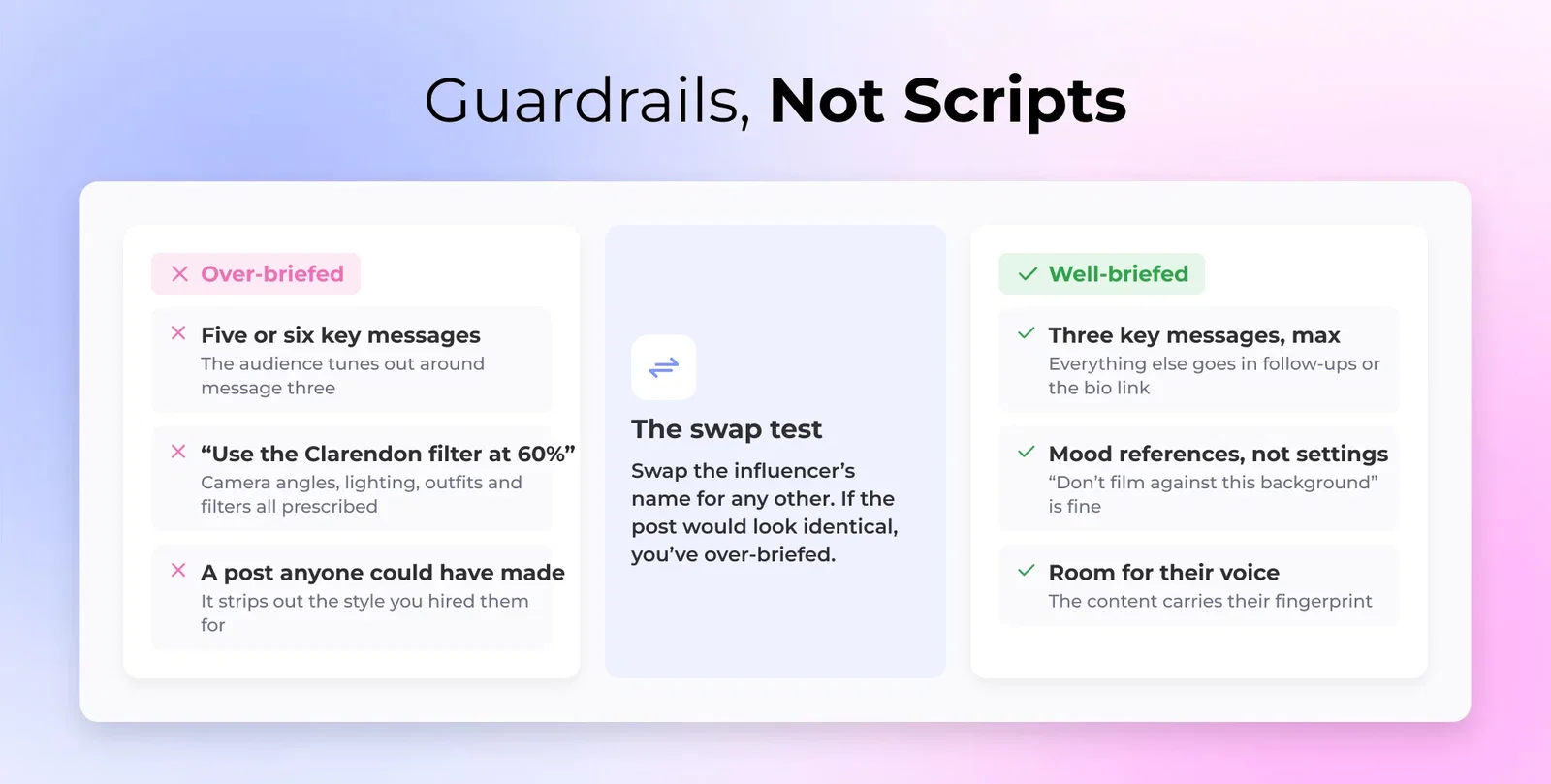
More than three key messages. The most underperforming sponsored post tries to cover four, five, or six things at once. The product benefits, the brand story, the discount code, the seasonal hook, the campaign hashtag. The audience tunes out around message three.
Pick the three that matter most for the campaign goal and cut the rest. The dropped points can live in follow-up content, the bio link, or a second post.
Overly restrictive visual guidelines. Prescribing camera angles, lighting setups, exact outfits, or specific filters strips the content of the influencer's natural style, which is the reason you hired them in the first place. Mood references are fine. "Don't film against this background" is fine. "Use the Clarendon filter at 60% strength" is not.

A useful test: swap the influencer's name in the brief for any other influencer's. If the post would look identical, you've over-briefed. The whole point of working with influencers is that the content carries their fingerprint.

Influencer brief examples: good vs bad
A real brief example clarifies the difference faster than a checklist.
Bad brief excerpt:
"Please post a Reel about our new face serum. Mention that it's clean and effective. Tag us @brand. Use #ad. Make sure the lighting is good. Send for approval first."
The brand voice is invisible. The goal is unstated. The deliverables are vague. The disclosure placement isn't specified. The approval process has no timeline. The influencer will guess at half the inputs, and the post will reflect that.
Good brief excerpt:
"Post one Instagram Reel, 30–45 seconds, vertical, going live Tuesday October 14 between 7pm and 9pm CET, cross-posted to TikTok within 48 hours. Goal: drive checkout. KPI: click-throughs to product page via your unique link in bio. Three key messages: the serum is reef-safe, daily use is safe, code JANE15 gets 15% off until October 31. Tone: warm, conversational, slightly self-deprecating. Avoid: comparing to other brands by name, claims about treating acne (say 'helps with breakouts' instead). Disclosure: '#ad' in first line of caption, Paid Partnership label on the post. Storyboard review by Oct 8, final cut by Oct 12, 48-hour brand turnaround on each round."
Every line is actionable. The influencer can shoot from this. The brand gets a post that reflects the campaign goal, the brand voice, and the legal requirements without three rounds of telephone.
How long should an influencer brief be?
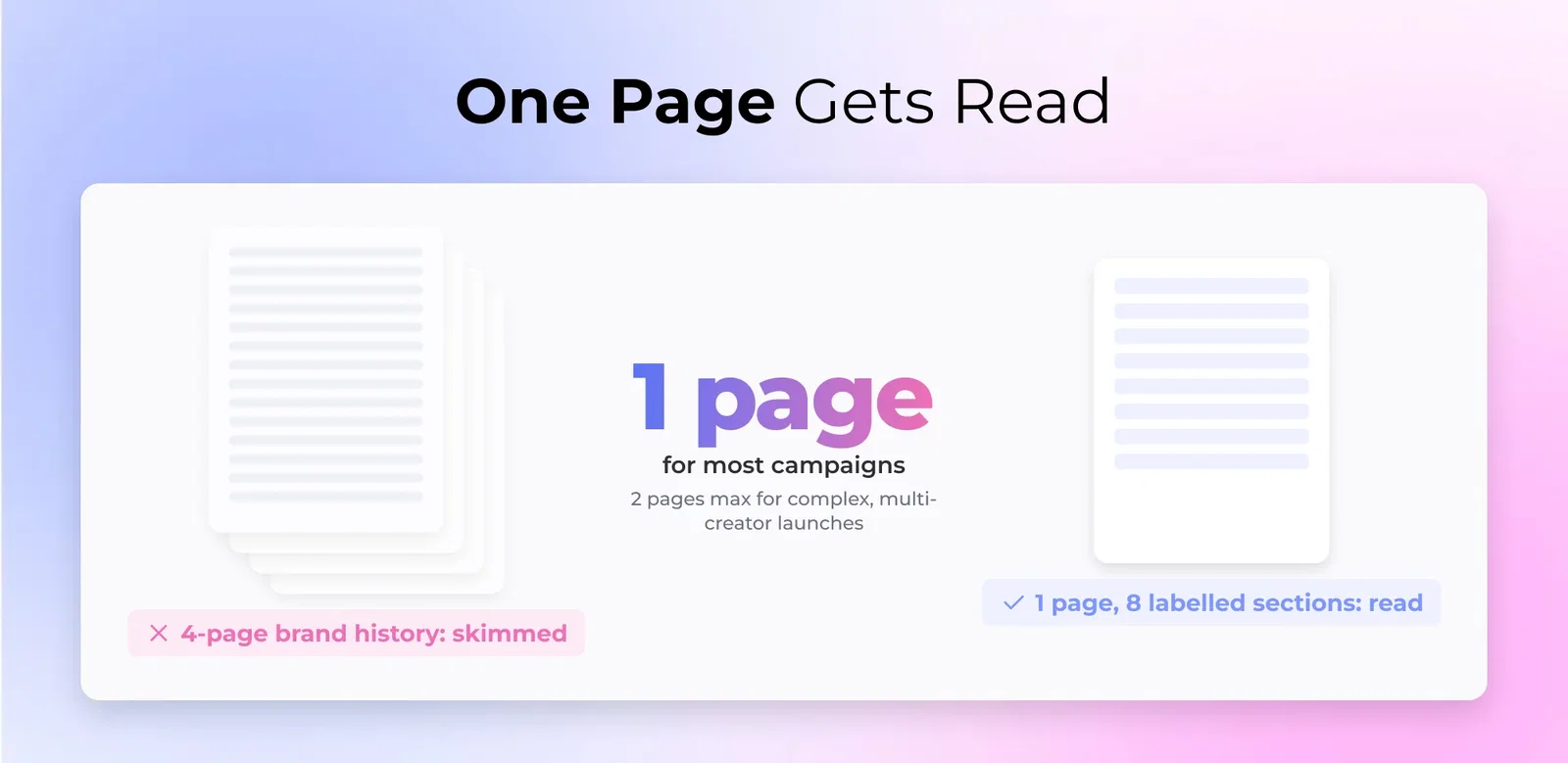
One page for most campaigns. Two pages maximum for complex multi-deliverable launches across several influencers and content formats.
Influencers read briefs the way users read terms of service. They scan for the parts that affect them and skip the rest. A four-page brand history doesn't get read. A one-page brief with eight clearly labelled sections does.
Before you draft the brief, run your brand deck, product page, or research notes through a text summarizer to distill the must-know points and hook ideas. Use that distilled TL;DR to create a clear influencer brief that fits on one page, keeps messages under three, and is easy for creators to scan on mobile.

If your brief is over two pages, cut these first:
- Brand history paragraphs that go past three sentences
- Long-form audience descriptions (a two-line summary works)
- Mood boards pasted inside the brief itself (link them in a separate doc)
- Step-by-step explanations of how to shoot vertical video
The brief is a working document, not a brand bible. If the influencer wants to dig deeper, keep the bible in a separate link.

How Influee structures influencer briefs
A blank document is where most briefs go wrong. The brand sits down to write, misses two of the eight elements, and the influencer notices the gap a week later when the deliverable date is already locked.
Influee's Campaign Editor builds the brief inside the influencer marketing platform, section by section. Every campaign uses the same structure, so brands stop reinventing the brief from scratch and influencers see the same format every time they apply to a campaign.
The Editor breaks the brief into four blocks:
- Basic Details: campaign name, dates, cover photo, and the goal you're optimizing for. This is where the campaign objective gets locked before any other element.
- Collab Rules: tone of voice, competitor exclusions, logo placement, disclosure language, usage rights, and approval flow. The non-negotiables sit in one place, so the influencer can read them once and refer back.
- Brief for Creating Content: content format and platform, posting schedule, talking points, hook ideas, CTA wording, and reference content. Brands who want to provide a full script can; brands who only want to set talking points and let the influencer write can do that instead. The structure flexes.
- Recruitment Specifications: which nano influencer, micro influencer, or macro tiers can apply, niche filters, audience country, and budget per collaboration. The brief and the targeting live in the same workflow.
Two things this changes day to day:
- Missing elements get caught at campaign setup, not after the influencer asks. The Editor prompts you for every required section before the brief goes live.
- Brand background, tone, disclosure language, and usage terms get reused across campaigns automatically. You write the framework once and the platform delivers it cleanly to every influencer on every campaign.
Micro & nano influencers starting at £98
20,000+ Vetted Influencers in UK
FAQ
What is an influencer brief?

An influencer brief is a document that gives an influencer the brand context, campaign goal, deliverables, key messages, and rules they need to produce sponsored content. Without it, the post drifts away from the brand and the campaign goal.
What should be included in an influencer brief?
An influencer brief should include eight elements: brand overview, campaign goal, deliverables, key messages, what to avoid, disclosure requirements, usage rights, and approval process. Anything beyond those eight is usually padding and gets skimmed.
How do you write a brief for an influencer?
You write a brief for an influencer by filling in those eight elements in plain language and keeping the total length to one page. Lead with the goal and the deliverables, then layer in the brand voice, the talking points, and the rules. On Influee, the Campaign Editor walks brands through each section so nothing gets dropped before the brief reaches the influencer.
How long should an influencer brief be?
An influencer brief should be one page for most campaigns and two pages maximum for complex multi-influencer launches. Influencers skim briefs, and long ones lose the parts that matter to the inbox-scanning treatment.
Do you need a brief for a gifting campaign?
You need a brief for a gifting campaign even though no post is required. A gifting brief is shorter, usually a half page covering brand background, the product story, disclosure language, and a note that posting is optional. For the full gifting playbook, influencer gifting walks through the structure.
Table of Contents

What is an influencer brief?
What to include in an influencer brief
Influencer brief template: copy and paste
What NOT to include in an influencer brief
Influencer brief examples: good vs bad
How long should an influencer brief be?
How Influee structures influencer briefs
FAQ

Work with influencers from UK
UK

Sifa

London

Lucia
Colchester

Tasha
Surrey

Maddie
BECKENHAM