


Influencer Marketing Statistics for 2026: The Numbers That Matter
8 April 2026

Written By Katja Orel
Lead Editor, UGC Marketing

Fact Checked By Sebastian Novin
Co-Founder & COO, Influee
There's no shortage of influencer marketing statistics floating around. The problem is that most roundups are data dumps: 40 bullet points with no context, no "so what," and no brand lens.
This is a different kind of stats article. Every number here was picked because it answers a question brand marketers are actually asking: Does influencer marketing work? What does it cost? Which creators drive the best results? Where should I spend?
These are the influencer marketing statistics that matter for 2026: organised by the decisions they help you make, with a line on what each one means for your campaign.

Is Influencer Marketing Actually Worth It?

The short answer: yes. Here's what the data says.
Influencer marketing returns an average of $5.78 for every $1 spent. That's across all tiers, platforms, and verticals. For micro and nano campaigns with lower base costs, the ratio often skews even higher, because engagement rates are stronger and creator fees are a fraction of macro pricing. (Source)
49% of consumers make a purchase at least once a month because of influencer content. Not once a year. Once a month. That's recurring, habitual buying behaviour driven by creators, not a one-off spike after a viral post.
86% of consumers have made at least one influencer-driven purchase in the past year. That's not a niche audience segment. That's the mainstream. If your brand isn't showing up in creator content, you're absent from a purchase path most consumers already use.
94% of marketers say influencer marketing is an effective strategy. The debate about whether the channel "works" is over. The question now is how you run it: which creators, which platforms, which formats, and how you measure results.
What this means for your campaign: The effectiveness question is settled. If influencer marketing isn't delivering for your brand, the issue isn't the channel: it's how it's being run. For a step-by-step framework, check our guide on influencer marketing strategy.
How Big Is the Influencer Marketing Industry?

Big, and getting bigger every year.
The global influencer marketing industry is projected to reach $33 billion+ in 2025. That's up from $21.1 billion in 2023. The growth rate isn't slowing: it's accelerating as brands shift budget from traditional paid channels into creator-driven content. (Source)
59% of marketers plan to increase their influencer marketing budget in 2025. Not maintain: increase. That's a clear signal: the brands already doing influencer marketing are doubling down, not pulling back. Most are reallocating from paid social, where CPMs keep climbing and creative fatigue sets in faster.
Average influencer CPM has dropped 53% year-over-year. This is the stat that should get your CFO's attention. While Meta and TikTok ad costs trend upward, influencer marketing is getting cheaper to run. More supply (more creators entering the space), better tools, and a shift toward micro/nano tiers are all driving costs down.
What this means for your campaign: The influencer marketing industry isn't an experiment anymore: it's a maturing, cost-efficient channel. If you've been waiting to test it, the economics have never been more favourable. And if you're already running campaigns, the data supports scaling. For budget planning, see our guide on influencer marketing budget.
Which Creator Tier Performs Best?
This is the section most stat roundups skim over. It's also the one that matters most for how you actually spend.
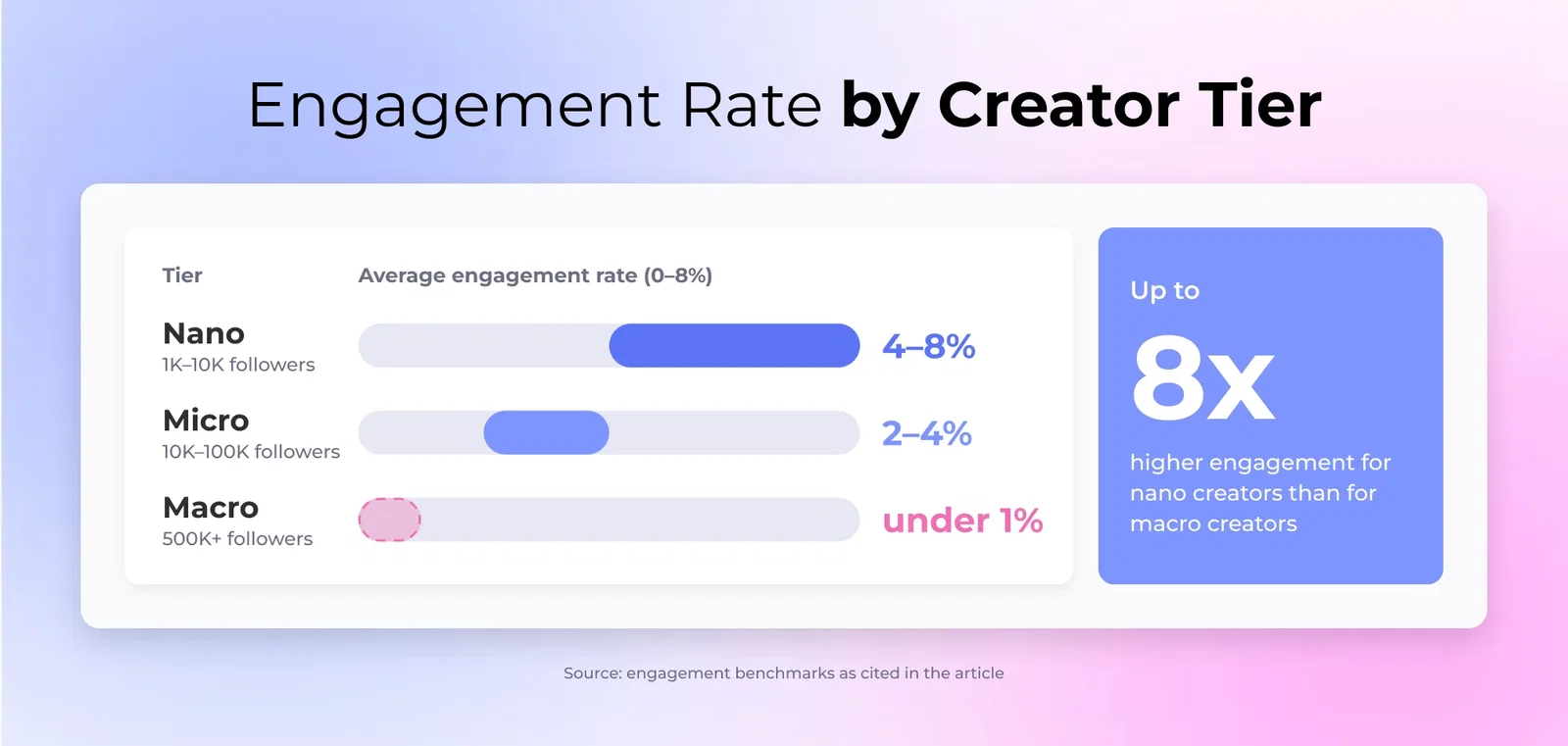
Nano influencers (1K–10K followers) average 4–8% engagement rates. Micro influencers (10K–100K) average 2–4%. Macro influencers (500K+) typically land under 1%. The pattern is consistent across platforms and verticals: smaller audiences, higher engagement. That's not a fluke: it's the physics of trust. A creator who knows their 5,000 followers by comment thread carries more weight than one broadcasting to a million strangers.
Brand ambassador programmes deliver the highest ROI compared to one-off campaigns. A single sponsored post gives you a data point. A three-month partnership with the same creator builds audience familiarity, compounds trust, and drives repeat purchase behaviour. The math always favours consistency over one-offs.
83% of creators are willing to work for gifting alone if they genuinely like the product. That's a massive lever for nano and micro seeding campaigns. If your product is good and the brand fit is right, you can activate 20–50 creators at the cost of product and shipping, generating a library of authentic content with near-zero creator fees.
What this means for your campaign: If you're working with a budget under $10K/month, influencers in the US are the default. You get more content, more audience segments, and more data to optimise from, for the same spend that would buy you one macro post. Platforms like influencer marketing platform make it easy to find and manage micro and nano creators at scale.
Which Platform Should You Use?

Platform choice should follow your audience, not the latest trend. Here's what the data says about where influencer marketing performs best.
TikTok delivered 11.8% short-term ROI in a Dentsu study, and 75% of advertisers say TikTok influencers gave them their highest ROI. TikTok's algorithm rewards content quality over follower count, which makes it the best platform for discovery and awareness campaigns. A nano creator with 3,000 followers can hit 500K views if the content resonates. That doesn't happen on Instagram.
Instagram remains the strongest platform for nano and micro sponsored content and long-term ambassador programmes. Instagram's conversion infrastructure (link stickers, shopping tags, DM automation) makes it the better choice when you need to track the path from creator post to purchase. For ongoing partnerships where you're building sustained audience trust, Instagram's ecosystem supports that better than TikTok's feed-driven discovery model.
YouTube drives deeper consideration for high-ticket and complex products. Longer content means more time to explain, demonstrate, and build purchase intent. If you're selling something that needs a 5-minute explanation rather than a 15-second hook, YouTube influencer partnerships drive stronger conversion on considered purchases: think tech, SaaS, fitness equipment, or skincare routines.
What this means for your campaign: Don't split across too many platforms early on. If you're optimising for awareness and discovery, start on TikTok. If conversions and trackable ROI are the priority, start on Instagram. YouTube is the play for products that need explanation. Pick one, learn what works, then expand.
How Do Consumers Actually Respond to Influencer Content?

Reach doesn't convert. Trust does. Here's what actually drives consumer action.
64% of consumers say they're most compelled by genuine reviews from creators. 55% are driven by discount codes. The takeaway: authenticity and incentive work together. A creator who genuinely uses your product and shares a real take (paired with a clear reason to buy now) is the highest-converting combination. Scripted endorsements without either element fall flat.

Consumers are 80% more willing to buy from brands with long-term influencer partnerships compared to one-off sponsored posts. This is the stat that should reshape how you structure campaigns. One post from one creator is a touchpoint. Three posts from the same creator over two months is a relationship the audience sees and trusts. Consistency compounds.
29% of consumers share product feedback directly with influencers, and for Gen Z, that number jumps to 41%. Creators aren't just a distribution channel. They're a feedback loop. Consumers tell creators what they think about products, and creators relay that sentiment back, giving brands a direct line to real customer insight they wouldn't get from surveys or reviews.
What this means for your campaign: Stop optimising for reach and start optimising for trust. Long-term partnerships with creators who genuinely use your product will outperform big-name one-off placements every time. Build a roster, not a campaign. For more on measuring what trust actually drives, see our guide on influencer marketing ROI.
What Does Influencer Marketing Actually Cost?

Less than most brands assume, especially at the micro and nano tier.
50% of influencers charge between $250 and $1,000 per post. That's the median range across all tiers and platforms. At the nano level, rates start as low as $10–$100. At the micro level, $100–$500. You don't need a $50K budget to run influencer marketing: you need a smart allocation.
71% of creators offer discounts for longer-term partnerships. This is where the economics get interesting. A creator who charges $500 for a one-off post might do a 3-month package at $350/post. Multiply that across a roster of 10 creators and the savings are significant, plus you get the compounding trust benefit of repeat exposure.
83% of creators will work for product gifting alone if the brand fit is right. For nano and micro seeding campaigns (where you're activating 20–50 creators at once), this means your primary cost is product and shipping, not creator fees. It's the most cost-efficient way to generate a volume of authentic content.
What this means for your campaign: Budget is more flexible than most brands think. A focused micro influencer campaign can launch for under $5,000. The key is matching your creator tier to your budget, and locking in long-term deals where the per-post economics improve over time. For a full breakdown, read our influencer marketing budget guide.

Micro & nano influencers starting at £98

20,000+ Vetted Creators in UK
Does the Content Have Legs After the Campaign?

One of the most undervalued aspects of influencer marketing: the content doesn't expire when the campaign ends.
41% of brands say repurposing creator content in paid ads delivers higher ROI than studio-produced creative. Creator content feels native. It looks like what people already scroll through. When you run it as a paid ad (through whitelisting or spark ads), it doesn't trigger the ad-avoidance reflex that polished brand creative does. The result: higher click-through rates, lower CPAs, and better ROAS.
Influencer-generated content (IGC) consistently outperforms polished brand creative in paid social feeds. This isn't anecdotal: it's a pattern across verticals. The content performs because it was made by someone who understands the platform natively. A creator shoots for the feed. A production team shoots for a brand guideline. Audiences can tell the difference in the first half-second.

Content reuse extends the value of every dollar spent beyond the campaign window. A single creator video can become a paid ad, a landing page hero, an email asset, and a product page testimonial. When you negotiate content rights upfront (which platforms like Influee include by default), that one piece of content keeps working months after the campaign ends.
What this means for your campaign: Factor content asset value into your ROI calculation from day one. The creator fee isn't just buying you a post: it's buying you a content asset you can run across every channel. That changes the cost-per-result math dramatically. For more on measuring the full value of influencer campaigns, read our influencer marketing ROI guide.
Micro & nano influencers starting at £98
20,000+ Vetted Creators in UK
FAQ
Does influencer marketing actually work?

Influencer marketing works, and the data is definitive. The channel returns an average of $5.78 for every $1 spent, 86% of consumers have made an influencer-driven purchase in the past year, and 94% of marketers rate it as an effective strategy. The question isn't whether it works, but how well you run it.
How big is the influencer marketing industry?
The influencer marketing industry is projected to reach $33 billion+ globally in 2025. Growth is driven by brands shifting budget from traditional paid social into creator-driven content, with 59% of marketers planning to increase their influencer spend.
What is the average ROI of influencer marketing?
The average ROI of influencer marketing is $5.78 returned for every $1 spent. Micro and nano influencer campaigns often exceed this benchmark due to higher engagement rates and lower creator costs.
Which influencer tier has the highest engagement rate?
Nano influencers (1K–10K followers) have the highest engagement rates at 4–8%, compared to 2–4% for micro influencers and under 1% for macro influencers. Smaller audiences produce higher trust and more meaningful interaction per post.
How much do influencers charge per post?
Influencer rates range from $10–$100 per post for nano creators to $5,000+ for macro influencers. 50% of influencers charge between $250 and $1,000 per post, and 83% are willing to work for product gifting alone if the brand fit is right.
Is TikTok or Instagram better for influencer marketing?
TikTok is better for awareness and discovery campaigns: it delivered 11.8% short-term ROI in a Dentsu study, and its algorithm rewards content quality over follower count. Instagram is stronger for conversion-focused campaigns and long-term ambassador partnerships, thanks to its shopping infrastructure and link tools.
Table of Contents

Is Influencer Marketing Actually Worth It?
How Big Is the Influencer Marketing Industry?
Which Creator Tier Performs Best?
Which Platform Should You Use?
How Do Consumers Actually Respond to Influencer Content?
What Does Influencer Marketing Actually Cost?
Does the Content Have Legs After the Campaign?
FAQ

Work with influencers from UK
UK

Nathan

London

Kayleigh
N/A

Maria
London

Faye
Surrey