


Influencer Gifting and Product Seeding: A Brand's Guide
7 May 2026

Written By Katja Orel
Lead Editor, UGC Marketing

Fact Checked By Sebastian Novin
Co-Founder & COO, Influee
Influencer gifting is one of the most cost-efficient tactics in influencer marketing, and one of the most misunderstood. Send a product, get organic content back. In theory.
In practice, most brands ship products and hear nothing. The ones that consistently get content back run gifting as an actual operation: targeted lists, structured outreach, clear rights, real follow-up.
This guide covers what gifting and product seeding actually are, why brands invest in them, the brands doing it well, the four reasons campaigns fail, and a step-by-step on running one that produces content.

What Is Influencer Gifting, and Is It the Same as Product Seeding?

Influencer gifting is sending free product to an influencer with no requirement to post in return.
Product seeding is the same idea applied at scale. Instead of one box to one influencer, brands seed product to dozens or hundreds of influencers at once, treating the campaign as a top-of-funnel content engine.
In day-to-day usage, the two terms are interchangeable. The distinction only matters if you're sizing a campaign: any one-off send is "gifting", a coordinated drop to dozens or hundreds of influencers in one push is "product seeding".
Both fall under the broader umbrella of influencer marketing campaigns, and both follow the same legal rule. Free product counts as material consideration. If an influencer posts about it, the FTC requires disclosure regardless of whether you paid them. The FTC recommends clear tags like "#ad" or "#advertisement"; vaguer ones like "#gifted" or "#collab" alone are widely used in industry but the regulator has flagged them as potentially insufficient on their own.
The takeaway: gifting is not a workaround for paid partnerships. It's a different tactic with different mechanics, and the rules still apply.
Why Brands Use Influencer Gifting

Gifting sits in influencer marketing budgets for four specific reasons.
1. Cost-efficient at scale
There's no per-post fee. The cost is the product plus shipping plus the small operational lift to coordinate the send. For a DTC brand with healthy margins, the marginal cost of an extra unit out the door is often under $20.
Send 50 boxes, get 15 posts back, and the cost per piece of content lands well below what a single mid-tier fee would have produced. That's why gifting tends to take a meaningful share of the influencer marketing budget at brands that have the operational setup to run it.
2. Posts read as organic, not as ads
An influencer who chose to post about a gifted product writes a different caption than one fulfilling a contract. The video is looser, the language is theirs, the comments section reflects real interest. Audiences notice, and posts that look like genuine discovery outperform posts that look like deliverables.
3. It builds long-term influencer relationships
Gifting is the easiest first step toward long-term influencer relationships. Send the product, see who posts, see who keeps using it, then convert the strongest fits into paid partnerships, affiliates, or a brand ambassador program. Some of the most efficient long-term rosters are built this way: cheap test, double down on the few that worked.
4. The content becomes a reusable asset
Any post that comes back can be repurposed if you have usage rights. That can be a clause in the gifting brief, a paragraph in a follow-up email, or a quick DM exchange.
Without rights, the post stays on the influencer's account and you can't run it as an ad. With rights, you can boost it as a paid social ad, embed it on the product page, or run it through influencer whitelisting so it runs as an ad from the influencer's own handle.

One gifted unit can produce a single post, or that post plus six months of ad creative. The difference is whether you asked.
Brands That Do Influencer Gifting Well

Three brand examples cover most of what works in gifting today. Each runs a different mechanic, and each one is replicable on a smaller budget.
OLIPOP: Product Seeding at Scale
OLIPOP scaled product seeding into a core acquisition channel by sending product to a large pool of nano and micro influencers across food, lifestyle, and wellness niches. There's no guaranteed post on most sends. The bet is volume: enough influencers receive product, enough of them genuinely like it, and the organic posts compound on TikTok and Instagram.
The mechanic only works because the product is shareable. A pastel-coloured can of "healthy soda" photographs well and slots into the fridge-restock and grocery-haul content nano influencers already make. Takeaway: scale works when the product earns the post on its own merits.
Glossier: Customers as Gifted Influencers
Glossier's gifting strategy started inside its own customer list. The brand identified existing buyers who already posted about the products on their own accounts, then sent additional product, early access, and reps the influencer could share with their audience.
The pipeline is closed-loop: customer becomes fan, fan becomes gifted influencer, gifted influencer becomes affiliate or ambassador. The cost of acquisition is essentially zero. Takeaway: your most effective gifted influencers may already be on your order export.
Mejuri: Gifting Plus Affiliate
Mejuri pairs nano influencer gifting with affiliate links. The influencer receives the product without a posting obligation, but if they do post, unique affiliate links and influencer discount codes earn them a commission on every sale.
That single change shifts the post-rate math. The influencer now has a reason to post beyond just liking the product, and the brand only pays when posts drive revenue. Takeaway: pairing gifting with commission aligns incentives without upfront fees.
The mechanics above don't require a multi-million-dollar budget. The blocker for most brands is sourcing: where to find influencers whose audiences match the product and whose engagement is real.
An influencer marketing platform removes that bottleneck. Influee's vetted influencer pool is filtered for engagement quality and audience authenticity upfront, so a gifting send goes to influencers who already cleared the bar most brands waste weeks on. From there, the workflow is the same: brief, ship, repurpose with full content rights.
Why Most Influencer Gifting Campaigns Fail

Most brands that try gifting once and write it off fail for one of four reasons. None of them are about the product.
1. Sending to the wrong influencers
Mismatched selection is the single biggest failure mode. A skincare brand sending product to a fitness influencer with a 0.5% engagement rate and a bot-heavy follower base will hear nothing, and even if they get a post, it won't drive anything. Niche fit, audience demographics, and engagement quality matter more than follower count. Fake influencers exist at every tier, and gifting at scale is where they slip through most often, simply because you can't deeply vet 50 or 100 sends in one push.
2. No brief, or a brief that's too vague
A box arriving on an influencer's doorstep with no context is a guessing game. They don't know if you want a post, a story, a Reel, a feed photo, or nothing at all. Most default to nothing because nothing is the safest option.
A gifting brief solves this without crossing into paid-post territory. The brief is a suggestion document, not a contract: it tells the influencer what good content might look like and what rights would apply if they post, while explicitly stating there's no obligation to post anything. That distinction lifts post rates without making the relationship feel transactional. More on what belongs in it below.

3. Bait-and-switch on obligation
Three valid models exist: pure gifting (no obligation), barter (same obligations as a paid post, but the influencer is paid in product instead of cash), and paid partnerships (cash plus deliverables). All three work, as long as both sides know which one they're in.
The failure mode is hybrid: a brief that says "no obligation to post" followed by chasing influencers for posts, demanding edits, or threatening to "remove them from the program". Influencers recognise the switch and stop responding, often across the entire roster you share contacts with.
Pick a model upfront and stick to it. If you need a guaranteed post, write a barter or paid agreement with clear deliverables. Don't dress an obligation up as a gift.
4. No follow-up after the gift lands
Most brands ship the box and forget. The influencers who post hear nothing back. The influencers who don't post are never asked why. Gifting only compounds when the brand treats it as the start of a relationship. A one-line "thanks for posting, here's another product to try" beats most outreach campaigns at converting nano influencers into long-term partners.
How to Run an Influencer Gifting Campaign
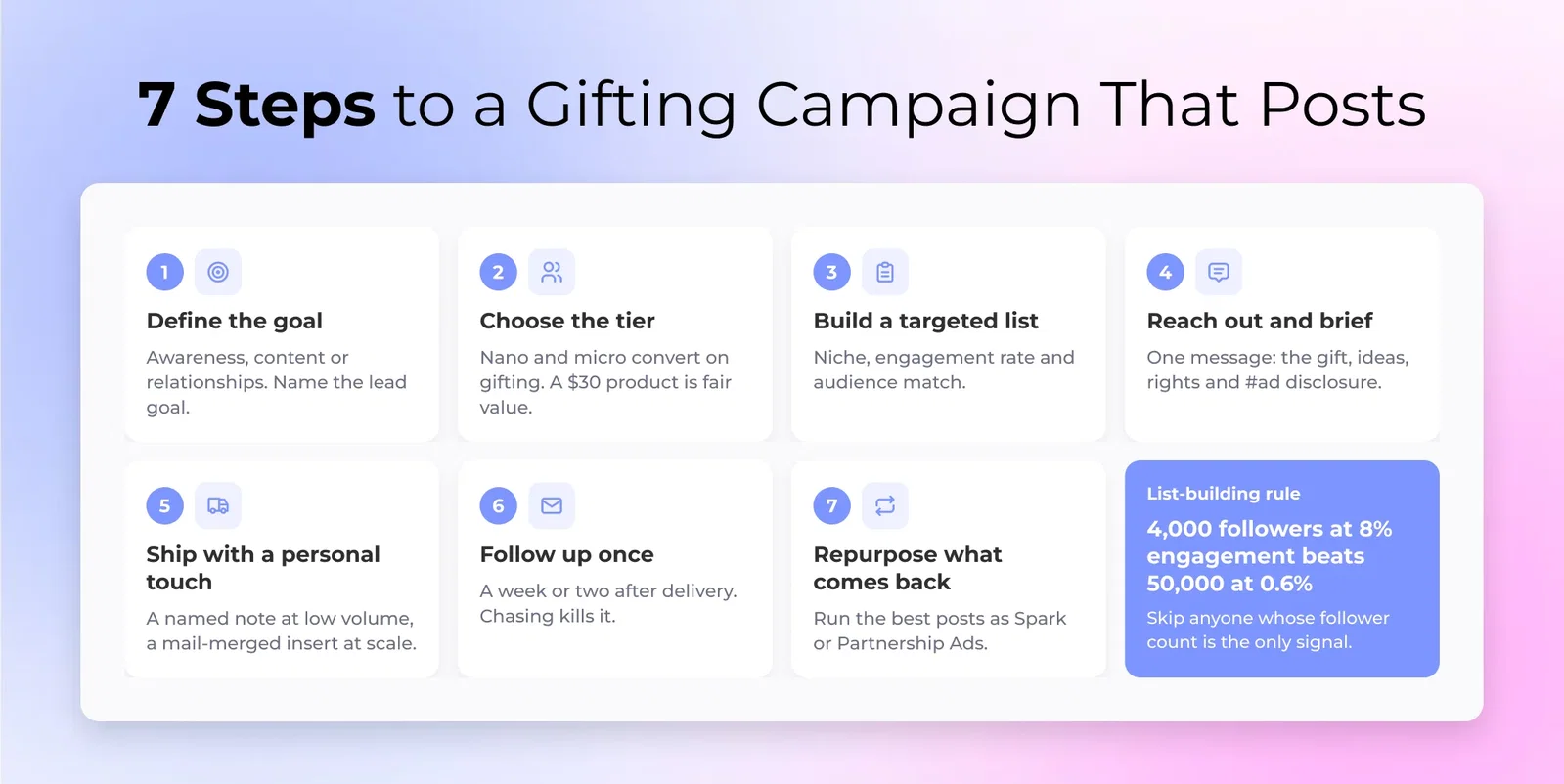
A working gifting campaign breaks into seven steps, in this order.
1. Define the goal first
Gifting usually targets one of three goals: awareness, content generation, or relationship building.
They look similar on a slide but pull a campaign in different directions.
Awareness leans toward volume and a broad niche. Content generation leans toward a smaller list of higher-production influencers with usage rights agreed upfront. Relationship building leans toward depth, repeated touchpoints, and a plan to convert top performers into paid work.
The trade-off is real if you're sourcing manually. The time it takes to vet 100 unknown accounts is the same time it takes to deeply brief 20.
Working from an already-vetted influencer pool collapses that trade-off. The engagement and audience quality have already been screened, so a single campaign can chase volume and quality at the same time.
Either way, name the lead goal upfront and plan against it.
2. Choose the right tier
Nano influencer and micro influencer tiers convert on gifting better than larger ones.
The math is simple: a $30 product is roughly what a nano influencer would charge for a post, so the gifted item already feels like fair value. Smaller accounts also post more often and accept a wider range of content fit.
Larger influencers tend to treat unsolicited boxes as ignorable, or as the opening move in a paid negotiation. Gifting at that tier rarely converts without a fee attached.
3. Build a targeted influencer list
Filter on three things: niche alignment, engagement rate, audience match.
Skip anyone whose follower count is the only signal. A 4,000-follower influencer with 8% engagement and an audience that overlaps your customer base will outperform a 50,000-follower account with 0.6% engagement every time.
The cost of getting this step wrong is the entire campaign.
4. Reach out and brief them in the same message
Don't send cold boxes to addresses you scraped from a contact form. The first contact is a DM, email, or whatever channel the influencer actively uses, and it does double duty: confirms they want the product, and sets the terms.
A working outreach message covers six things in a paragraph or two:
- Who the brand is and why you reached out specifically to them.
- What the product is and what makes it interesting.
- That you'd like to send it as a gift, with no posting obligation.
- Two or three suggested ways they might feature it, framed as ideas not requirements.
- How content rights would work if they choose to post (e.g. brand can repost or boost as a paid ad with credit).
- The disclosure expectation if they post: "#ad" or "#advertisement", per FTC guidance.
By the time they say yes, the briefing is essentially done. Then ask for a current shipping address.
Keep the whole thing under a screen's worth of text.
Length isn't what separates gifting from a paid deal. Obligation and payment are.
But a long, clause-heavy message will still scare people off, because it reads as overcomplicated for a free product.
5. Ship the product with a personal touch
Ship promptly once they've agreed, and include something that signals "we know who you are" rather than "you are the next address on a fulfilment spreadsheet". The form depends on volume.
At low volume (10–50 sends), a short handwritten or hand-typed note that uses the influencer's name and references something specific from their content does more than any PR mailer. It's the easiest differentiator at this scale and most brands skip it.
At high volume (hundreds or thousands of sends), handwritten doesn't scale. Use a printed insert with the influencer's first name and one line of relevant context, mail-merged into the fulfilment workflow. It's not as personal as handwriting, but it still beats a generic press release in the box.
Optionally include a printed one-pager that reiterates the suggested usage, rights, and disclosure expectation from the outreach. It's a reminder, not new information.
6. Follow up once, not five times
One follow-up message a week or two after delivery, asking how they're getting on with the product, is enough. It opens the door without pressuring a post. Repeated chasing kills the relationship.
7. Repurpose what comes back
Every post the campaign produces is a content asset. Save it, tag it, brief the paid social team.
Set up a shared folder or asset library where every gifted post gets logged the day it goes live. Tag each one with the influencer's handle, the date, the platform, the product, and the rights status (granted, requested, declined). That metadata is what lets the paid social team pull the right asset weeks later without chasing screenshots.

The strongest gifting ROI comes from running the best organic posts as paid ads through whitelisting, TikTok Spark Ads, or Meta Partnership Ads, not from the organic reach alone. A single high-performing gifted Reel boosted as a Spark Ad will usually outproduce the entire rest of the campaign in attributable revenue.
Gifting vs Paid Influencer Partnerships: When to Use Each

Gifting and paid partnerships are not in competition. Most mature influencer programs run both, in the right places, for the right reasons.
Use gifting when:
- The campaign needs creator content that performs as paid ad creative. Gifted posts repurposed as Spark Ads or Partnership Ads regularly outperform brand-produced ad creative on CTR and conversion.
- The brand needs niche coverage that one paid contract can't deliver. Twenty gifted micro influencers across adjacent niches reach audiences a single macro deal won't touch, for the same total spend.
- The roster needs a low-risk vetting layer. Gifting filters creators in real conditions: the ones who post and drive engagement go onto the paid retainer list, the rest don't, no fees burnt either way.
- The brand needs continuous creator presence between paid campaign bursts. Gifting fills the months when paid budget isn't running, so creator-led mentions stay live across the calendar.
Use paid partnerships when:
- The campaign needs guaranteed deliverables on a fixed timeline (a launch, a sale, a specific window).
- You need specific content formats produced to a brief, not whatever the influencer chose to make.
- The campaign is large enough that locking in deliverables is worth the per-post fee.
Use both when:
- You want to test fit before scaling spend. Gift broadly, identify the influencers whose posts performed, then pay them for follow-on content with full rights and ad usage.
One limitation worth flagging: gifting is not a fast channel. A gifting campaign typically takes four to eight weeks from list-building to first organic posts, and the post rate is rarely above 30% even when the campaign is well-run. If the brand needs creative live in two weeks for a launch, gifting won't get there. Run paid for the launch and queue gifting in parallel for the long tail.

Micro & nano influencers starting at A$60

5,000+ Vetted Influencers in Australia
FAQ
Is product seeding the same as influencer gifting?

Product seeding is influencer gifting at scale. Both involve sending free product to influencers without a posting requirement, and the terms are used interchangeably in most brand and agency conversations. The only practical difference is volume.
Do influencers have to post if they receive a gift?
Influencers do not have to post about a gifted product unless a written agreement says otherwise. Standard gifting is no-obligation by design, and a clean campaign states that explicitly in the brief. If you require a post, that's a paid partnership, not gifting.
Is influencer gifting worth it?
Influencer gifting is worth it when the product is genuinely shareable, the influencer list is well-targeted, and the brand can wait weeks rather than days for posts. It's the lowest cost-per-content tactic in the channel, and a poor fit when guaranteed deliverables on a fixed timeline are required.
What is the difference between gifting and paid influencer marketing?
The difference between gifting and paid influencer marketing is obligation. Gifting sends free product without a posting requirement, and the influencer decides whether to post. Paid partnerships involve a contract, a brief, fixed deliverables, and a fee. Gifting trades certainty for cost; paid trades cost for certainty.
Does gifted content need FTC disclosure?
Gifted content needs FTC disclosure. The regulator treats free product as material consideration regardless of whether the brand paid the influencer, and the disclosure has to be clear to a reader scrolling at speed. "#ad" or "#advertisement" is the safest format; vaguer tags like "#gifted" or "#collab" alone have been flagged as potentially insufficient.
Table of Contents

What Is Influencer Gifting, and Is It the Same as Product Seeding?
Why Brands Use Influencer Gifting
Brands That Do Influencer Gifting Well
Why Most Influencer Gifting Campaigns Fail
How to Run an Influencer Gifting Campaign
Gifting vs Paid Influencer Partnerships: When to Use Each
FAQ

Work with influencers from Australia
Australia

Genevieve

Shoalhaven

Sandy
Sydney

Holly
Perth

Brittney
Brisbane