


Influencer Marketing: The Complete Strategy Guide for Brands in 2026
11 June 2026

Written By Katja Orel
Lead Editor, UGC Marketing

Fact Checked By Sebastian Novin
Co-Founder & COO, Influee
Influencer marketing is what brands do when they pay people with engaged audiences to talk about their products. That trust is the product. It's the part you can't buy on Meta Ads Manager.
The industry is now worth over $24 billion globally, and most of that growth is not flowing to celebrities. It's flowing to nano and micro influencers with 1,000 to 100,000 followers, because the math on big-name partnerships stopped working years ago. Brands chasing reach through macro and celebrity influencers are optimising for vanity metrics. Brands chasing conversion through nano and micro work are optimising for results.
This guide covers how influencer marketing actually works in 2026: the campaign types that deliver ROI, the tier framework that decides whether a campaign performs, what each platform is good for, how much it costs, how to measure it, and how to launch your first campaign without burning the budget.

What is influencer marketing?
Influencer marketing is the practice of partnering with influencers who have built an engaged social media audience to promote your brand, product, or service. It works because the influencer already has the audience trust the brand is trying to earn.
Traditional advertising puts the brand in front of an audience. Influencer marketing puts a trusted voice in front of an audience that already chose to listen.
Today the channel runs on nano and micro influencers: niche audiences driving measurable purchase intent at a fraction of what celebrity endorsements cost. A modern brand might pick 20 accounts under 50K followers, each aligned to a specific buyer segment. The economics work because the trust does.

How does influencer marketing work
The basic flow is the same across every campaign. The brand identifies the right influencers, sends a brief, agrees on deliverables and compensation, the influencer creates and publishes the content, and the brand measures the result.
Running that flow by hand (vetting each influencer, negotiating rates, signing contracts, chasing content rights) is where the real work lives. An influencer marketing platform folds those steps into one workflow, which is why brands running at any volume tend to start there instead of managing partnerships over email and spreadsheets.
The variables that change everything sit underneath that flow:
- Platform. Instagram, TikTok, YouTube, or LinkedIn.
- Tier. Types of influencers split into nano, micro, macro, and mega.
- Campaign type. Six standard influencer marketing campaigns cover almost every goal: gifting, paid post, affiliate, ambassador, content rights, or co-created.
- Compensation model. Flat fee, performance-based, gifted product only, or a hybrid.
Every one of those choices shifts the economics and the expected outcome.
Timing matters as much as choice. A typical paid partnership runs four to six weeks from first outreach to published content. Two weeks for sourcing and contracting, one week for the influencer to draft and shoot, several days for brand review and revisions, then the publish window. Seeding campaigns can be faster because there's no scripted content to approve. Ambassador programmes run on quarterly cycles instead of one-off timelines.
What separates influencer marketing from paid social ads is the asset you're buying. With Meta Ads Manager, you buy impressions targeted to a demographic. With influencer marketing, you buy access to an existing relationship. The audience already trusts the influencer, which means the message gets through filters that paid ads bounce off. That's why influencer content frequently outperforms studio creative when it's repurposed as paid media: it doesn't read as an ad in the first half-second.

Influencer marketing strategies and campaign types
Most influencer campaigns fall into six categories. Each one has a different cost structure, deliverable, and ideal tier.
Product seeding and gifting. You send free product to influencers, no contractual posting obligation. Some post organically, some don't. The volume math on influencer gifting: 50 nano influencers gifted means 10–20 posts at zero media cost. Best for new product launches, low-budget testing, and brands building a long-term roster from the bottom up.
Paid partnerships. Flat fee in exchange for a specific deliverable: one Instagram Reel, three TikTok videos, a YouTube integration. Usage rights and revisions are negotiated up front. Works across all tiers; rates climb fast above micro. Partnership Ads on Meta and Spark Ads on TikTok extend the same post into paid distribution from the influencer's handle, which keeps the trust signal intact.
Affiliate and commission. The influencer earns a percentage of sales tracked through a unique link or promo code. Zero risk on the brand side because there's no upfront fee, but only a subset of influencers will accept commission-only deals. Strongest model for DTC brands with proven conversion. Pair it with the workflow in affiliate marketing vs influencer marketing to decide where one model beats the other.
Ambassador programmes. Long-term partnerships, often 3–12 months, where the influencer posts multiple times across the contract window. A brand ambassador program can run on a paid retainer, commission plus product, or a hybrid. Best for brands that want consistent presence in a community rather than one-shot spikes.
Content rights deals. The influencer creates content for the brand to use on its own channels, with no requirement to post it to their audience. The brand gets a content asset plus full usage rights; the influencer gets paid for production. Useful when you want a specific influencer's aesthetic on your paid ads or product pages without buying their audience reach. Platforms like Influee bundle production and full content rights by default, which makes these deals smoother to run at scale than chasing rights post-shoot over DM.
Co-created content. The brand and influencer collaborate on a product, capsule collection, or content series. Highest production value, highest commitment, longest timeline. Reserved for brands with strong influencer fit and a clear creative concept.
Gifting and affiliate models work best at the nano and micro tier because the relationships there are still genuine. Small audiences haven't yet been monetised into transactional followings, so a free product or a 10% commission still moves them. Push the same models at the macro tier and they break: an influencer with 800K followers won't open the box for free, and their audience knows it.

Influencer tiers: which strategy works at each level
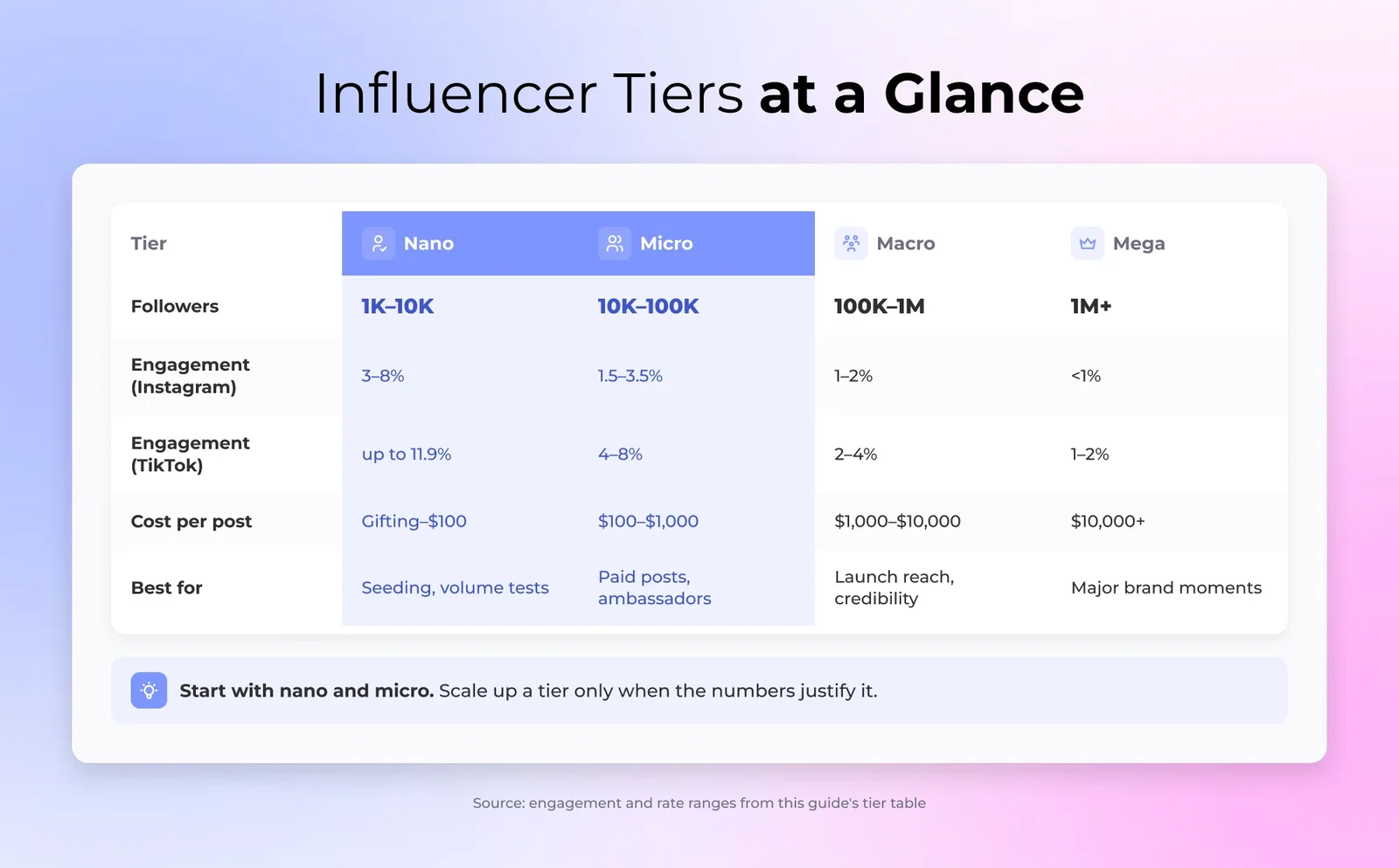
Tier matters because it changes everything: cost, engagement rate, content style, audience size, and which campaign types make sense. The framework below maps each level to the work it does best.
Followers | Typical Engagement Rate | Cost Per Post | Best For | |
|---|---|---|---|---|
Nano | 1K–10K | 3–8% (IG) / up to 11.9% (TikTok) | Gifting–$100 | Seeding, volume tests |
Micro | 10K–100K | 1.5–3.5% (IG) / 4–8% (TikTok) | $100–$1,000 | Paid posts, ambassador |
Macro | 100K–1M | 1–2% (IG) / 2–4% (TikTok) | $1,000–$10,000 | Launch reach, credibility |
Mega | 1M+ | <1% (IG) / 1–2% (TikTok) | $10,000+ | Major brand moments |
Nano and micro consistently outperform macro on engagement rate and cost per engagement. The math is simple: a nano influencer at 5% engagement on 5,000 followers delivers 250 interactions for the cost of a sample. A macro influencer at 0.8% engagement on 800,000 followers delivers 6,400 interactions for $8,000. The macro post produces more total engagements, but each one costs roughly $1.25, against close to zero for the nano post. Multiply nano by 20 partners and the comparison tilts.
Macro and mega tiers still have a role: a flagship product launch, a credibility play with a known name, a campaign where reach matters more than action. They aren't the default. Most brands should start with micro influencer and nano partnerships, identify the top performers in the data, and only scale up the tier when the economics justify it.
Platforms: where influencer marketing works best
Each platform has its own economics, content format, and tier sweet spot. Pick the wrong one and even the best influencer underperforms.
Instagram. The strongest Instagram influencer marketing surface for paid partnerships, ambassador programmes, and shoppable content via Reels and Stories. Best tiers: nano and micro for engagement, mid-tier for reach. The shopping infrastructure (link stickers, product tags, collabs) makes it the strongest platform for direct conversion.
TikTok. Fastest organic discovery on any platform. The algorithm rewards content quality over follower count, which means a nano influencer with a strong hook can outperform a million-follower account on the same video. Best for product seeding, viral moments, and Gen Z audiences.
YouTube. Long-form, high-intent, strongest for affiliate. A 12-minute video review converts at rates other platforms can't match because the viewer has self-selected into deep engagement. Best for considered purchases like software, supplements, tech, and big-ticket products where the audience needs a longer pitch. For brands running paid distribution alongside the organic integration, YouTube video ads extend the same creator coverage into pre-roll and mid-roll inventory.
LinkedIn. B2B influencer marketing runs on a different rhythm. The audience is decision-makers, not consumers, and the content is thought leadership, not lifestyle. Best for B2B SaaS, services, and enterprise products with long sales cycles.
The cross-platform pattern in 2026: Instagram for conversion, TikTok for discovery, YouTube for depth, LinkedIn for B2B. Most brands need two of the four. Few benefit from running all of them at once. Ecommerce influencer marketing typically runs Instagram and TikTok in parallel, leaning on the conversion side for revenue and the discovery side for cheap top-of-funnel reach.

How much does influencer marketing cost?
Influencer marketing costs scale with tier, platform, and content format. At the nano tier, you can run a 20-influencer seeding campaign for the cost of product samples plus a small shipping budget. At the macro tier, a single Instagram Reel can clear $5,000 before usage rights are added. Across the middle, micro influencer paid posts typically land between $100 and $1,000.
Instagram influencer pricing tends to run higher than TikTok influencer rates for equivalent follower counts because the conversion infrastructure is stronger. YouTube long-form integrations command the highest rates per video because the production and the runtime are both larger.
Usage rights add a separate line. If you plan to run the influencer's content as paid ads on your brand channels, expect to pay 20–50% on top of the base fee. Some brands negotiate this into a flat package; others handle it post-campaign once the top performers are clear. Either approach works as long as the rights are explicit in the contract before the content is shot.
The total influencer marketing budget picture is more useful than the per-post number.
Working with 20 nano influencers at gifting plus a $50 honorarium each costs roughly $1,000 in cash plus product. That buys you 20 voices in 20 audience segments.
Working with one macro influencer for a single Reel costs $5,000+ for one piece of content from one voice to one audience. That buys you reach.
The first approach gives you more content, more audience segments, and more performance data to optimise from. The second gives you scale. Both are legitimate; one is the default for most brand budgets.

Micro & nano influencers starting at A$59

5,000+ Vetted Influencers in Australia
Does influencer marketing work?
Influencer marketing returns an average of $5.78 for every $1 spent across tiers and verticals. That benchmark covers everything from celebrity deals to nano seeding programmes. Nano and micro campaigns frequently exceed it because the engagement-to-cost ratio is sharper. The influencer marketing ROI math gets sharper still once you factor in content reuse: a single influencer post can run as a paid ad, a product page hero, and an email asset on top of its original reach.

OLIPOP. Built early growth on nano and micro seeding at scale. Hundreds of small influencers received product and posted organically in food, wellness, and lifestyle niches. The play was volume across many small accounts, not one big-name placement.
Gymshark. Built a selective athlete roster on long retainers and gave them creative freedom over scripts. The result was a recognisable visual identity carried by people who actually trained in the product.
Glossier. Turned customers into influencers by making it easy and rewarding for everyday buyers to post about the product. Every new customer became a potential post; the brand's identity grew out of the network of people posting about it.
The pattern across all three: many smaller partnerships instead of one big one, niche fit over raw reach, long-term relationships over one-shot drops. None led with a single celebrity placement; they built rosters and scaled the partnerships that performed. That distributed approach is one of the defining influencer marketing trends of the past three years.

Key influencer marketing statistics
A handful of numbers from the full influencer marketing statistics data set that should shape any 2026 plan:
- The influencer marketing industry is projected at $33 billion globally in 2025, up from $24 billion a year earlier.
- 59% of marketers plan to increase influencer marketing budgets in 2026, with most of the increase routed to smaller tiers.
- Nano influencers deliver engagement rates of 3–8% on Instagram and up to 11.9% on TikTok, compared with under 1% for macro on Instagram.
- Industry estimates put the annual cost of influencer fraud at $1.3 billion globally, concentrated at the macro and mega tier where fake followers are easier to mask.
- 86% of consumers say they've made a purchase influenced by an influencer's recommendation in the past year.

How to measure influencer marketing
Pick influencer marketing KPIs based on the campaign goal, not the deliverable. A seeding campaign and a paid Reel can use the same influencer, the same product, and the same brief, and they need to be measured differently.
For awareness campaigns: track reach, impressions, and follower growth. These tell you how many people saw the content. They don't tell you whether the campaign worked, only whether anyone noticed.
For engagement campaigns: track engagement rate, save rate, and comment quality. Engagement rate matters more than absolute numbers. A nano post with 800 likes on 4,000 followers (20%) signals stronger audience trust than a macro post with 8,000 likes on 800,000 followers (1%).
For conversion campaigns: track clicks, conversions, and cost per acquisition through promo codes and UTM links. Set up a unique promo code per influencer and a UTM-tagged link for every placement before the campaign launches. Without that infrastructure, attribution becomes guesswork.
The setup matters. In Meta Ads Manager, build a separate ad set per influencer when running paid amplification. That gives you per-influencer CPA data, the most actionable conversion-side number you'll collect. For organic tracking, hand each influencer a unique discount code (the influencer's name or handle works) and a shortlink with UTM parameters (source=influencer, medium=organic, campaign=spring-launch, content=influencer-handle). Pipe both into the same dashboard your paid ads run through.
Attribution windows matter too. Influencer-driven sales rarely land on the day the post goes live. A 7-day click and 1-day view window is the default for most ecommerce stacks, but for considered purchases the real lift often shows up across a 14- to 28-day window. Run a baseline week before the campaign, then compare sales velocity during and after. The lift is the campaign's true result; last-click attribution alone will systematically undercount it.
Nano and micro campaigns are easier to measure than macro, because each influencer has a smaller, more defined audience. You can see which influencer, which audience, and which message moved the needle, instead of guessing why a single $10,000 placement under- or overperformed.
Micro & nano influencers starting at A$59
5,000+ Vetted Influencers in Australia
Influencer marketing pros and cons
The pros and cons influencer marketing trade comes down to trust at scale versus the operational overhead of running it.
Pros. Influencer content reads as trustworthy in a way brand content can't, which is why authenticity in influencer marketing matters more than production polish at the nano and micro tier. The targeting is built in. A fitness influencer's audience is already filtered for fitness interest, which means you start with audience-product fit before a single ad euro is spent. At nano and micro scale, the cost per engagement beats almost every paid channel. The content asset compounds: a single influencer post becomes a paid ad, a product page testimonial, an email creative, and a landing page hero.
Cons. Results aren't guaranteed; the same influencer who delivered last quarter can underperform this quarter. Fraud risk climbs steeply at macro and mega tier. Measurement adds operational overhead: UTMs, promo codes, dashboards. Coordinating 20 nano partnerships takes more project management than 2 macro ones, which is the real reason brands sometimes default to the bigger names even when the math says otherwise.

How to avoid fake influencers
Fake follower fraud concentrates at the macro and mega tier, where larger numbers create more places to hide. At nano and micro scale, the math is easier to audit because you can read every comment and check every recent post.
Engagement rate vs benchmark. Compare the influencer's engagement rate to the tier average. Nano should hit 3–8% on Instagram; micro should hit 1.5–3.5%. An influencer significantly below tier benchmark with high follower count is usually carrying inflated numbers.
Follower growth history. Look at the growth curve over the past year. Steady, organic growth is what you want. Sudden spikes, like 50K followers added in a week with no viral content to explain them, are a red flag.
Audience demographics. Look at where the followers live, their reported age, and their interests. An influencer based in the US whose audience is 60% from outside Western markets is selling reach you can't convert.
Comment quality. Read the last 20 posts' comments. Generic phrases ("Nice post!", emoji-only replies, repeated comments across accounts) signal engagement pods or bots. Real audiences leave specific, contextual responses.
Cross-platform check. Real influencers usually have a presence on at least two platforms: Instagram and TikTok, or YouTube paired with a second feed. Single-platform accounts at scale, especially with sudden follower growth, are easier to fake. A consistent footprint across feeds suggests a real person operating the account. The rise of AI influencer marketing makes single-platform vetting even less reliable, since fully synthetic profiles can hold a consistent posting cadence on one feed without ever existing across multiple.
On Influee, fake influencers get filtered out before they're ever listed in the directory you browse. Engagement quality, audience demographics, and follower authenticity are checked by the platform team during onboarding, so any influencer you can book has already passed those filters. Cold DM outreach gives you none of that protection. You're vetting every account yourself, after the influencer's response has already opened a conversation.

Influencer marketing vs traditional marketing
Traditional advertising buys impressions. Influencer marketing buys trust. The difference shows up in the metrics.
Paid social and traditional channels run on a one-to-many broadcast model. The brand pays for distribution, the message goes out to a targeted audience, the audience filters most of it out. Influencer marketing inverts the structure. The message arrives wrapped in an existing relationship, so the filter is already lower. That's why engagement and conversion rates on influencer content frequently outperform paid social on the same product.
Cost per engagement at the micro and nano tier comes in well below paid Meta or TikTok ads in most verticals. Cost per conversion depends on attribution setup, but for DTC brands running affiliate or promo-coded campaigns, the gap is measurable.
The influencer marketing vs traditional marketing answer is rarely either-or. Most brands that win at influencer marketing run it alongside paid social, with influencer content recycled into paid ads through Spark and Partnership Ads. That handoff is the influencer whitelisting workflow: top organic posts become paid creative running from the influencer's handle. Run them serially or in parallel; the platform doesn't care, only the goal does.

FTC compliance and disclosure requirements
The rules are simple and non-negotiable. Any sponsored post that involves payment, free product, commission, or any other material connection between brand and influencer must be disclosed clearly to the audience. The FTC treats undisclosed sponsorship as deceptive advertising, and the brand is on the hook, not just the influencer.
Acceptable disclosure looks like #ad, #sponsored, or "Paid partnership with [brand]" placed at the start of the caption, not buried in the 15th hashtag. Platforms like Instagram and TikTok provide branded content tools that handle disclosure automatically when an influencer tags a brand partner; using those is the safest path.
Brand-side responsibility under the ftc influencer guidelines: the brief must include disclosure requirements, and every published post should be reviewed for compliance before it goes live. Skipping that step is a brand-side liability, not the influencer's problem alone.

How to get started with influencer marketing
The order matters. Most failed campaigns are failures of influencer marketing strategy sequencing, not creativity.
1. Define the goal. Awareness, engagement, or conversion. Be specific. "Increase IG followers by 20% in Q2" is a goal; "do something on TikTok" isn't.
2. Set the budget. A realistic starting budget for a first influencer campaign is $1,500–$5,000 if you're paying for posts, or product-cost-only if you're gifting. Lower than that, you can't run enough partnerships to learn anything.
3. Pick the platform. Match the platform to the audience. Instagram for conversion, TikTok for discovery, YouTube for considered purchase, LinkedIn for B2B.
4. Pick the tier. Default to nano and micro. The economics are better, the engagement is higher, and the data you generate is more useful for scaling decisions. Move to macro only when you have a specific reach goal that smaller tiers can't hit on the budget.
5. Find the influencers. Pick a discovery platform from the major influencer marketing tools, search hashtags, or pull from your tagged content. The influencer brief should cover goal, deliverable, deadline, key message, brand do-not-touch list, and disclosure language. A workable structure: one line on the brand, three lines on the audience, the campaign goal in one sentence, the deliverable spec (format, length, platform), the must-includes (key claim, disclosure, link or code), and the must-avoids (competitor mentions, banned terms, off-brand visuals). Two pages maximum.
6. Brief, post, measure. Send the brief, approve content, publish, track results through promo codes and UTMs. Compare per-influencer performance after the campaign and double down on the top three.
7. Scale what works. Influencer marketing compounds. The partners who delivered in round one become the ambassador roster in round two. The ones who didn't perform get rotated out. That's how programmes get to ROI, not one-shot tests. Expect the third or fourth round to outperform the first by a wide margin, because by then the roster is filtered and the brief has been tuned against real performance data.
An influencer marketing platform like Influee removes the hardest parts of this sequence: sourcing vetted nano and micro partners, briefing, contracts, and content rights. The work that remains is picking, measuring, and scaling.
Most brands launch their first paid influencer campaign within two to four weeks once the platform is picked, the brief is written, and the first five influencers are confirmed. The work compresses from there as the roster builds.
Micro & nano influencers starting at A$59
5,000+ Vetted Influencers in Australia
FAQ
What are the 4 types of influencers?

Industry standard splits influencers into nano (1K–10K), micro (10K–100K), macro (100K–1M), and mega or celebrity (1M+). The more useful split is by what each tier is bought for: nano and micro are bought for conversion through peer trust, macro is bought for credibility through name recognition, mega is bought for one-shot reach.
Does influencer marketing work?
Yes, when run as an ongoing programme. The most common failure mode is treating it as a one-shot test: a single campaign rarely surfaces a clear winner, and brands conclude the channel doesn't work before the data is in. Brands that run three or four rounds, cut underperformers, and double down on top influencers consistently see returns improve.
How much does influencer marketing cost?
Total spend depends on volume and tier mix, not per-post rate. A $5,000 first budget can buy one macro Reel, 5–10 micro paid posts, or 30+ nano seedings with small honoraria. The same dollars typically perform better split across many smaller partnerships than concentrated in one.
What is the difference between influencer marketing and traditional marketing?
Traditional marketing is one brand voice broadcast through paid placement; influencer marketing is many trusted voices recommending to their own audiences. Traditional wins on cost-per-impression at scale. Influencer marketing wins on cost-per-conversion at nano and micro tier, where engagement and trust are highest.
Are nano and micro influencers better than macro for ROI?
For most brand budgets, yes. The cost-per-engagement gap is the clearest measure: nano runs roughly $0.50–$2 per engagement at seeding spend, while macro runs $5–$20 per engagement at flat-fee pricing. Macro wins only when the campaign goal is broad awareness and the success metric is reach, not conversion.
Table of Contents

What is influencer marketing?
How does influencer marketing work
Influencer marketing strategies and campaign types
Influencer tiers: which strategy works at each level
Platforms: where influencer marketing works best
How much does influencer marketing cost?
Does influencer marketing work?
Key influencer marketing statistics
How to measure influencer marketing
Influencer marketing pros and cons
How to avoid fake influencers
Influencer marketing vs traditional marketing
FTC compliance and disclosure requirements
How to get started with influencer marketing
FAQ

Work with influencers from Australia
Australia

Shenley

Kilmore

Chris
Caloundra West

Rachel
Melbourne

Sue
Canning Vale