


Influencer Relationship Management: A Practical Guide for Brands
16 June 2026

Written By Katja Orel
Lead Editor, UGC Marketing

Fact Checked By Sebastian Novin
Co-Founder & COO, Influee
Most brands treat influencer relationships as transactions. Brief, post, pay, done.
The brands getting the best results work differently. They build relationships that last across campaigns.
Repeat collaborators produce stronger content, negotiate less, and vouch for your brand more convincingly than any one-off partner. Over time, that turns a list of contacts into an asset.
Influencer relationship management is the system behind that shift. Here's what it is, why it pays off, and how to build a process that holds up as you scale from your first five influencers to fifty.

What is influencer relationship management?

Campaign-first one-off hiring versus relationship-first influencer management
Influencer relationship management is the ongoing process of building, maintaining, and improving your relationships with influencers across multiple campaigns. Some people call it creator relationship management or influencer CRM. The idea is the same: treat your influencers as long-term partners, not one-time vendors.
The difference from standard influencer marketing comes down to the starting point. One-off influencer marketing campaigns are campaign-first: you have a launch, you find influencers, you run it, everyone moves on. IRM is relationship-first: you build a roster of influencers you trust, and you bring them back campaign after campaign.
That distinction changes the economics. A repeat influencer already knows your product, your tone, and your audience. The brief gets shorter. The revisions get fewer. The content gets better, because they're not learning your brand from scratch every time.
It also changes how the audience reads the partnership. An influencer who mentions your brand once looks paid. One who's worked with you for six months looks convinced. That continuity is the whole point.
Why influencer relationship management matters

The three compounding business returns of repeat influencer partnerships
Repeat influencer partnerships generate 30% higher engagement than first-time collaborations. That's the short version of why IRM matters. The longer version comes down to three business reasons.
Better content over time. An influencer who has worked with you before knows what your audience responds to and what your brand will approve. They stop guessing.
The second campaign is sharper than the first, the third sharper than the second. You're compounding creative knowledge instead of resetting it every launch.
Lower effective cost. Around 71% of influencers offer discounts for longer-term partnerships, and repeat collaborators rarely push for top rate every round.
At the nano influencer tier, the savings compound fastest, because rates are low to begin with and repeat partners rarely charge full price twice. Work with a micro influencer often enough and influencer gifting or early product access can even replace part of the cash fee.
Audience trust. Followers notice the difference between a one-off sponsored post and an influencer who keeps showing up for the same brand. Repeat endorsements read as genuine preference, not a paid placement.
That's the trust that actually moves purchase intent, and it only comes from continuity.
One caveat: IRM only pays off if you run campaigns regularly. If you do a single launch a year, the overhead of maintaining a programme outweighs the return, and a one-off hire is the right call. The payoff comes from repetition.

Micro & nano influencers starting at A$60

5,000+ Vetted Creators in Australia
The key elements of influencer relationship management

The five day-to-day elements of influencer relationship management
IRM breaks down into five moving parts. Get these right and the relationship runs itself. Miss one and influencers drift to brands that manage them better.
Onboarding
The first campaign sets the tone for every one after it. Onboarding starts the moment an influencer says yes to your influencer outreach.
Send a clear first brief that covers expectations, brand guidelines, deliverables, timeline, and how you like to communicate. A strong influencer brief does more than describe the deliverable. It tells the influencer who your audience is, what's worked before, and where they have creative freedom.

Cover the basics once and you never repeat them: where to send drafts, how many revision rounds are included, when payment lands, and which rights you're buying. Getting that on the table during the first campaign saves the awkward mid-project clarifications that make a brand feel disorganized.
Nail onboarding and the influencer starts the relationship knowing exactly how to win with you.
Communication
Treat influencers as partners, not vendors. That means responsive, personal contact, not copy-pasted blasts.
Reply quickly, use their name, reference their last piece of content. The brands influencers want to work with again are the ones that make the working relationship feel like a relationship.
Performance tracking
You can't prioritize the right influencers if you don't know who drove results. Track each partnership against the influencer marketing KPIs that matter for your goal: engagement rate, reach, click-throughs, promo-code redemptions, cost per acquisition.
Pick one primary metric that maps to the campaign goal and rank against it. For a sales push, weight promo-code redemptions and cost per acquisition over raw views. The influencer with 30,000 views and 12 code redemptions beats the one with 200,000 views and two.
The point isn't a dashboard for its own sake. It's knowing exactly who to bring back next campaign and who to let go.
Content management
Every campaign produces assets, usage rights, and approvals you'll want again later. Keep a content library: what each influencer produced, which rights you hold, what you're cleared to repurpose into ads through influencer whitelisting or owned channels.
When full content rights come with the partnership, that library becomes reusable inventory instead of a licensing headache.
Retention
Keeping a top influencer engaged between campaigns is cheaper than having to hire influencers from scratch. Early access to products, exclusive drops, a quick feedback loop, the occasional check-in that isn't a brief: small gestures keep your best partners warm so they say yes faster next time.
The brands that retain best make their top influencers feel like insiders. Send the new product before it's public and ask what they think. Loop them in on which of their videos you're putting paid spend behind. Give them a real person to talk to instead of a shared inbox. None of it costs much, and it's the difference between an influencer who waits for your next brief and one who's already fielding offers from your competitors.
Common influencer relationship management mistakes
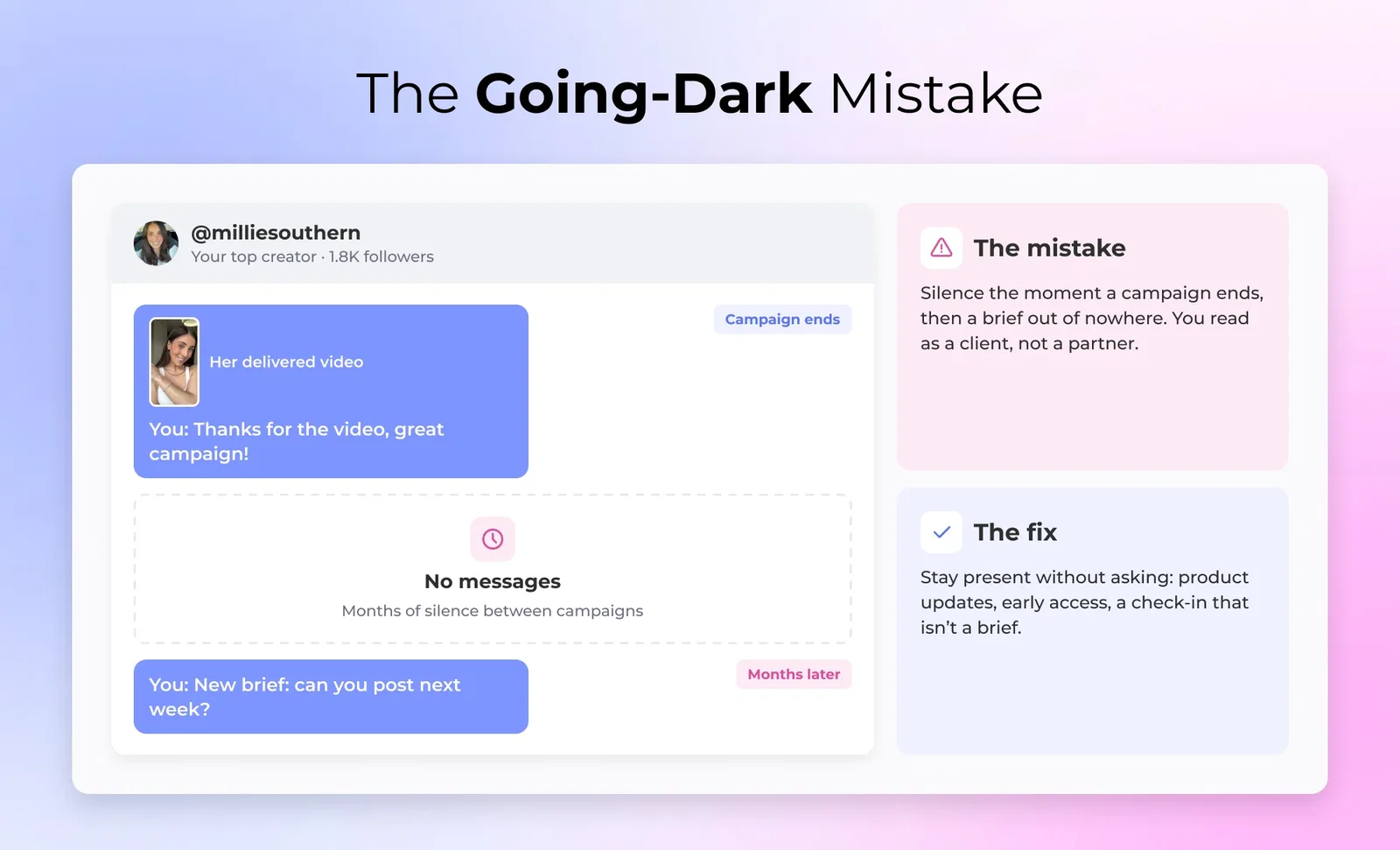
Common ways brands break influencer relationships without realizing it
Most IRM problems aren't strategy failures. They're small lapses that add up until your best influencers stop replying.
Going dark between campaigns. The fastest way to lose a good influencer is to go silent the moment a campaign ends, then reappear months later with a brief. The flip side does the same damage: only ever messaging when you need something, so every contact feels like a transaction. Either way you read as a client, not a partner, and your best people give their prime slots to brands that stayed close.
Briefing the same underperformers. Without performance history, you re-hire on memory and gut feel. That's how brands run a third campaign with an influencer who never converted, while the one who drove sales gets forgotten.
Leaving usage rights vague. Unclear rights upfront turn into disputes after the content is live, usually right when you want to put paid spend behind it. Settle what you can use, where, and for how long in the influencer contract before the first deliverable, not after.
Dragging your feet on payment. Nothing sours a partnership faster than chasing an unpaid invoice. An influencer who waits weeks for their money remembers it, and they'll either pad their next quote or pass on your brief. Pay on the agreed date, every time, and you become the brand they say yes to first.
Treating nano and micro influencers as interchangeable. They aren't, and they notice. A nano influencer with 4,000 engaged followers is a different partner than a micro influencer with 60,000: different rates, different expectations, different reasons for working with you. Lump them together in a mass email and the good ones opt out.
How to build a long-term influencer relationship programme

Turning ad-hoc influencer partnerships into a tiered long-term programme
A programme is just IRM with a system behind it. Here's how to turn ad-hoc partnerships into a repeatable engine.
1. Identify your top performers. After every campaign, rank influencers by the results that matter to you, not by follower count. Who drove sales, sign-ups, or saves? Those are the relationships worth investing in.
2. Follow up personally. Within a week of campaign close, reach out with specific feedback and a genuine thank-you. Tell them what performed, what you loved, and that you'd like to work together again. This single step puts you ahead of most brands, who go silent.
Keep it short and specific. Something like: "Hi [name], your second video drove the most saves of the whole campaign, and the hook in the first three seconds is exactly the kind of thing our audience responds to. Thank you for that. We've got a spring launch coming in a few weeks and I'd love to have you on it again. Can I send details closer to the date?" A message like that takes two minutes and makes the next yes easy.

3. Stay in contact between campaigns. Share product updates, send early access, invite top influencers into a small community or group chat, or learn how to send a mass text if you want to loop in your whole roster with one quick update. The goal is to stay present without always asking for something.
4. Build a tiered system. Not every influencer sits at the same level. Create tiers and move people up as the relationship deepens.
A simple three-tier structure works for most brands. Tier 1 is one-off collaborators you've worked with once and would use again. Tier 2 is repeat partners you bring back every two or three campaigns, with priority briefing and a standing rate. Tier 3 is ambassadors on an ongoing arrangement, with early access, a personal point of contact, and first refusal on new launches. An influencer earns their way up by performing, not by asking.
A brand ambassador program is the top tier of this system: your most loyal influencers representing you consistently rather than per campaign.
5. Document everything. Keep one record per influencer: rates, past content, usage rights, performance, personal notes. When you're managing five influencers you'll remember the details. At fifty you won't, and the record is what keeps the programme from collapsing back into guesswork.
Micro & nano influencers starting at A$60
5,000+ Vetted Creators in Australia
When does dedicated IRM software make sense?

When a campaign platform is enough versus when dedicated IRM software is worth it
Most brands never need one. A separate IRM tool exists to store relationship history, track who you've worked with, and keep partner data organized. If the influencer marketing platform you run campaigns on already does that, a second system just splits your data in two and adds work that didn't exist before.
That's the case for almost everyone running nano and micro campaigns. On Influee, the relationship workflow is already built in: briefs, approvals, revisions, payments, usage rights, and the full record of who delivered what. Every past rate, collaboration, and piece of content stays in one place, ready for the next campaign. There's nothing left for a standalone tool to manage, which is why influencer marketing tools built for campaign management do the whole job.
A dedicated relationship database only makes sense at genuine enterprise scale, when you're coordinating hundreds of partners across several teams at once. If you're operating there, you already know it. For everyone else, the campaign platform is the relationship system.
Influee's Agent MCP integration goes further still. It connects your campaign workflow to AI agents that handle the manual parts on their own: sorting performance, drafting follow-ups, organizing partner data, flagging who to bring back next. The busywork a separate IRM tool would put on your plate, Influee clears for you. Instead of bolting on another system to manage relationships, you run everything in one place and let the platform do the legwork.
Micro & nano influencers starting at A$60
5,000+ Vetted Creators in Australia
FAQ
What is influencer relationship management?

Influencer relationship management is the practice of building and maintaining long-term partnerships with influencers across multiple campaigns, rather than hiring them once and moving on. It treats influencers as ongoing partners instead of one-campaign hires, with the relationship actively kept up in the gaps between briefs.
Why is IRM important in influencer marketing?
IRM is important because repeat influencer partnerships outperform one-off hires on almost every metric. Established partners produce stronger content, negotiate more reasonably, and carry more credibility with their audience, which lowers your cost per result over time.
How do you build long-term influencer partnerships?
You build long-term influencer partnerships by treating your best performers as an asset worth keeping. Thank them quickly after a campaign, stay in light contact between projects, and give them a clear path to more work as they prove themselves. Influencers stick with brands that make the next collaboration feel inevitable rather than uncertain.
Do I need influencer relationship management software?
You need dedicated influencer relationship management software only at genuine enterprise scale, when you're coordinating hundreds of influencers across multiple teams. For everyone else, the platform you run campaigns on already stores the briefs, approvals, payments, rights, and history that make up the relationship workflow.
What is the difference between influencer management and influencer relationship management?
Influencer management is the operational side of running a single campaign: briefing, approving, and paying influencers for that project. Influencer relationship management is the longer game of nurturing those partnerships across many campaigns so the same influencers keep delivering.
Table of Contents

What is influencer relationship management?
Why influencer relationship management matters
The key elements of influencer relationship management
Common influencer relationship management mistakes
How to build a long-term influencer relationship programme
When does dedicated IRM software make sense?
FAQ

Work with influencers from Australia
Australia

Genevieve

Shoalhaven

Sandy
Sydney

Holly
Perth

Brittney
Brisbane