


How to A/B Test UGC Creative in Facebook Ads
September 18, 2026

Written By Katja Orel
Lead Editor, UGC Marketing

Fact Checked By Sebastian Novin
Co-Founder & COO, Influee
Most brands running Facebook ads change two things at once: the hook and the CTA, or the video length and the creator. Then the test finishes and nobody can say which change moved the number.
Changing two things at once isn't A/B testing, even if you call it that. Real A/B testing in Facebook ads isolates one variable, and for UGC-heavy ad accounts, that variable is almost always the creative itself.
This post covers what to test when your ads run on UGC creator content, how to set the test up in Meta Ads Manager, and how to read the results without jumping to conclusions.

What A/B testing in Facebook ads actually means
A/B testing in Facebook ads means running two ad versions that differ by exactly one variable, while audience, budget, placement, and time window stay identical.
Meta's built-in A/B test tool splits your audience automatically. Once enough people have seen both variants, it tells you whether the gap between them is real or just noise, the kind of small difference you'd see even between two copies of the same ad. Some advertisers run two matched ad sets manually inside the same campaign instead. Both work.

What to test when your ads use UGC creative
Six variables account for most of the swing in a UGC-heavy account. Test one at a time.
Hook format
Run a talking-head opener against a product-in-use shot, or against a text overlay stating the offer in the first two seconds. This shows whether your audience needs to see the product working before they'll watch on, or whether an emotional hook pulls them in first.
Creator style
Test a high-energy, fast-talking creator against a calm, relatable one, or against an aspirational tone. The winner tells you which register matches how your buyer sees themselves, not just who talks fastest on camera.
Video length
Run a 15-second cut against a 30-second cut of the same script, one pair at a time. A 15-second winner means you're dealing with a stop-scroll audience. A 30-second winner means people are watching through and want the full case.
CTA phrasing
Test a spoken "shop now" against a version where the creator implies the action without saying it. Some audiences respond to a direct ask, others read it as pushy. The test tells you which.
Format
Test video against a static UGC photo carrying the same message. Photos often run a lower CPM than video UGC ads, but only testing tells you if that holds for your product.
Creator count
Run one creator repeated across the ad set against two creators rotating. This shows how fast creative fatigue sets in for your audience, and whether rotation buys more runway before performance drops.

How to set up the test in Meta Ads Manager
In Ads Manager, go to Experiments and choose A/B Test, or click Create and select A/B Test at the campaign step. Build the test at the campaign level, not the ad set level, so Meta treats it as a controlled experiment instead of two ads competing for the same budget. Choose creative as the test variable, split the budget 50/50 between variants, and set the duration upfront.
Give it a minimum of seven days. Shorter windows only catch part of a weekly cycle, and Meta needs that much data to reach a reliable read. Don't touch either variant once the test starts. Even a small change invalidates the comparison.
Wait for Meta's significance flag before acting. One caveat Meta's own instructions skip: on lower-spend accounts, the flag takes longer to appear, because each variant needs enough volume to separate signal from noise. On a smaller daily budget per variant, plan for the test to run past seven days before Meta calls a winner.


UGC videos starting at $92

30,000+ Vetted Creators in USA
How to read the results without making bad decisions
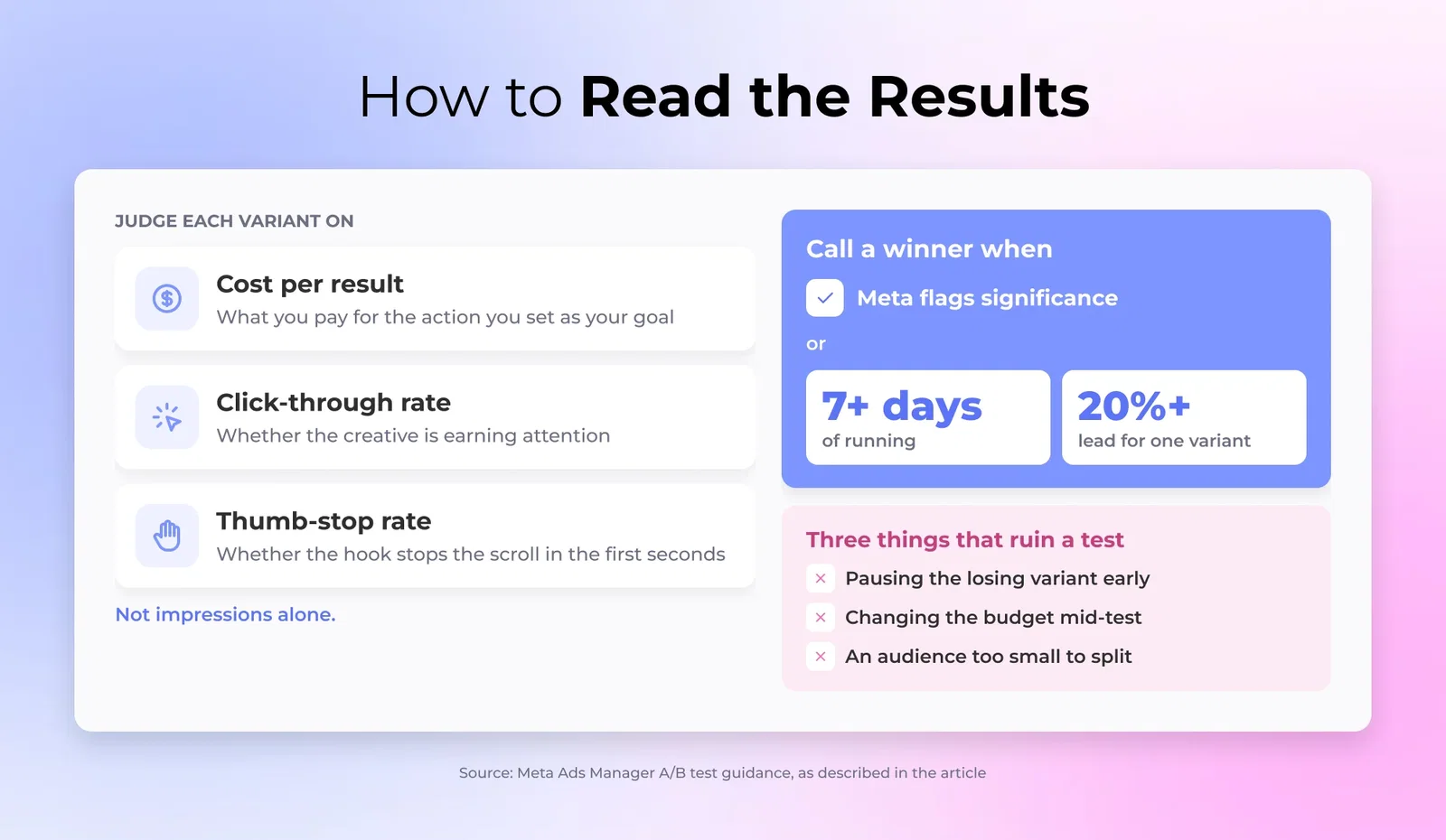
Three metrics matter more than total spend:
- Cost per result: what you're actually paying for the action you set as your goal. The Facebook ads benchmarks show what's typical for your industry, cost per result included.
- Click-through rate: check it against your good CTR Facebook ads benchmark to see if the creative is earning attention.
- Thumb-stop rate: how many people stop scrolling in the first few seconds. Shows whether the hook is working before the other numbers catch up.
Call a winner when Meta flags significance, or when you're past seven days and one variant leads by more than 20%. Anything closer than that is noise.
If neither variant pulls ahead, don't extend the test hoping for clarity. Try a different variable instead. Two hooks performing the same usually points to creator style or length as the real lever, not the hook itself.
Three things ruin a test once it's running:
- Pausing the losing variant early
- Changing the budget mid-test
- Testing on an audience too small to produce a reliable split
Getting UGC at scale
Running this kind of test depends on having more than one creator variant ready before you start. Briefing a single creator for a single video leaves nothing to test against.
The fix is a pipeline, not a one-off shoot: brief several creators at once through UGC creation, varying hook, format, and pacing across the batch, so a second variant is ready by the time the first one needs testing.
A/B testing Facebook ads with UGC creative comes down to three things: change one variable, give it seven days, and read the metric that actually answers your question.
Start with hook format. It's the variable most likely to move performance, and the one every UGC ad account already has multiple versions of, if more than one creator is on the brief.
UGC videos starting at $92
30,000+ Vetted Creators in USA
FAQ
What is A/B testing in Facebook ads?

A/B testing in Facebook ads means changing one thing between two ad versions and keeping everything else the same, so any performance difference is easy to trace back to that single change. The result shows which version of that one variable actually converts better.
How long should you run a Facebook ad A/B test?
A Facebook ad A/B test needs at least seven days to run. Less than that only covers part of a weekly cycle, and Meta doesn't have enough data yet to call a reliable winner.
What variables can you test in Meta Ads?
Meta Ads lets you test creative, audience, placement, and bidding as variables. In a UGC-heavy account, the creative-level details, hook, creator style, video length, CTA phrasing, format, and how many creators you rotate, are what move the needle most.
What is the difference between A/B testing and split testing on Facebook?
A/B testing and split testing on Facebook refer to the same practice. Meta uses both terms for its built-in tool that divides an audience between two ad variants and measures which one performs better.
How do you read Facebook A/B test results?
Reading Facebook A/B test results means checking for Meta's significance flag or a performance gap over 20% after at least seven days, using cost per result and thumb-stop rate rather than raw impressions.
Table of Contents

What A/B testing in Facebook ads actually means
What to test when your ads use UGC creative
How to set up the test in Meta Ads Manager
How to read the results without making bad decisions
Getting UGC at scale
FAQ

Work with UGC creators from USA
USA

Nicole

Portland

Anthony
Golden Valley

Courtney
Gainseville

Katie
St. Petersburg