


Dark Post on Instagram: What It Is and How to Use It
June 5, 2026

Written By Katja Orel
Lead Editor, UGC Marketing

Fact Checked By Sebastian Novin
Co-Founder & COO, Influee
A dark post on Instagram is an ad that never appears on anyone's feed organically. Only the targeted audience sees it.
For brands running influencer campaigns on Instagram, dark posts are the bridge between authentic influencer content and precise paid targeting. The influencer's creative runs as a paid ad to the exact audience you define, without ever showing on the influencer's or the brand's profile.
Here's what an Instagram dark post is, why influencer content makes the best ones, and how to set one up step by step.

What Is a Dark Post on Instagram?

A dark post on Instagram is an unpublished ad created in Meta Ads Manager that doesn't appear on the brand's or influencer's Instagram profile or feed. Only the targeted audience ever sees it.
Meta's own term for these is unpublished posts. Same format, different label. The point is that the post exists only as a paid placement: no organic distribution, no profile presence, no public visibility outside the audience you've defined in Ads Manager.
This matters for two reasons.
First, it lets you run multiple versions of the same campaign without flooding any feed with near-identical posts. Three hooks, four audiences, two CTAs, all live at once, none of them visible on a profile. The brand stays clean. The influencer stays clean. The ads run in the background.
Second, it gives you Meta's full targeting layer to work with. Custom audiences, lookalikes, retargeting, geographic precision, placement controls, dayparting. None of that is available on a standard organic Instagram post or a basic boosted post.
For brands running performance-focused Instagram influencer marketing campaigns, dark posts are the default ad format. The reach comes from paid targeting, not from the publisher's follower count.
Dark Post vs Boosted Post on Instagram
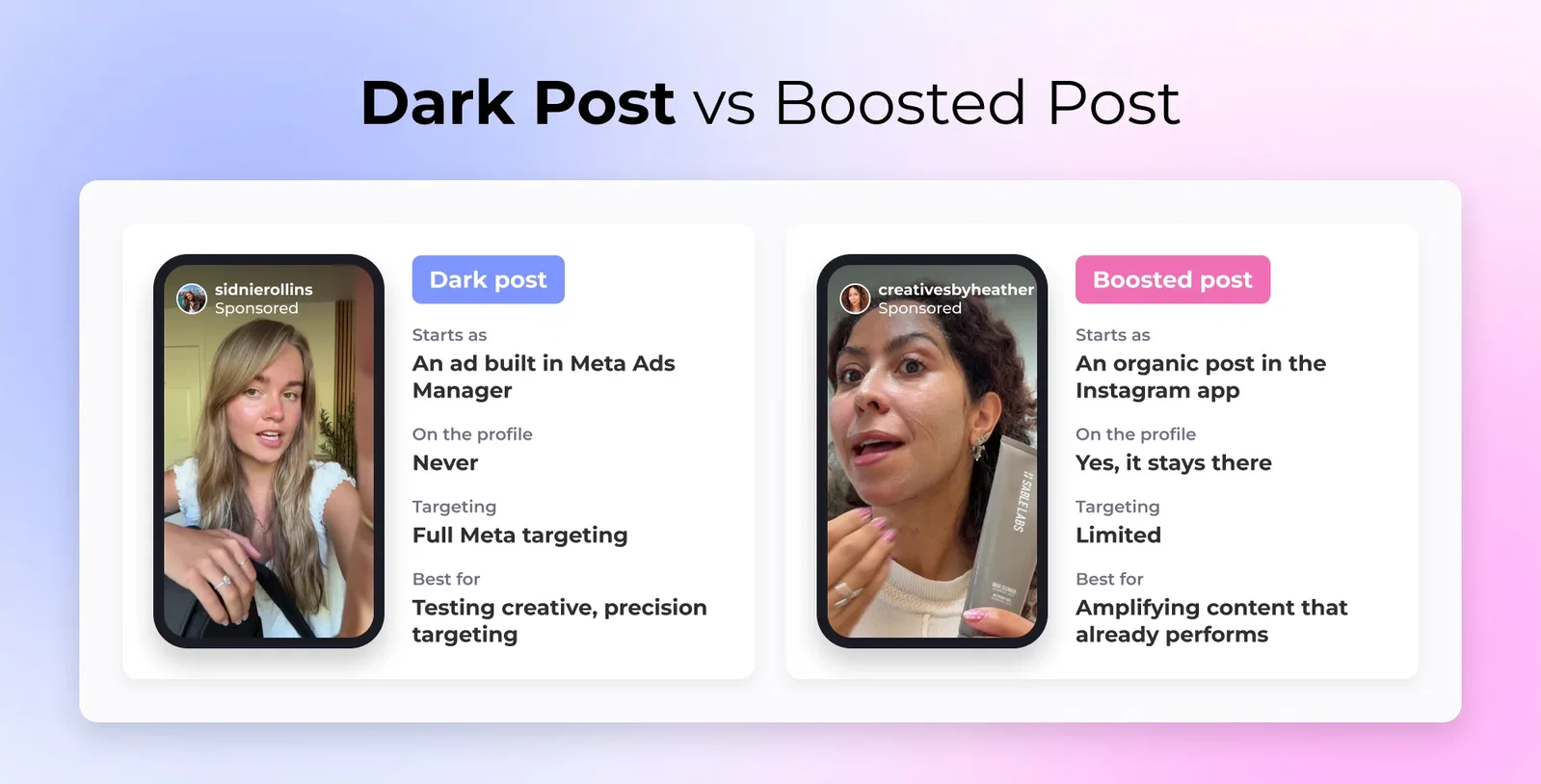
Both run as Instagram ads, but the format is different. A boosted post starts life as an organic Instagram post and then gets promoted with paid spend. A dark post is built as an ad from the start.
Dark post | Boosted post | |
|---|---|---|
Starts as an organic Instagram post | No | Yes |
Appears on the publisher's profile | No | Yes |
Created in | Meta Ads Manager | Instagram app |
Targeting | Full Meta targeting | Limited |
Best for | Testing creative, precision targeting | Amplifying content that already performs |
The practical difference matters for influencer campaigns. A boosted post means the influencer's existing followers see the ad in their feed alongside everyone else you target. A dark post serves only to the audience you define in Ads Manager, which keeps the influencer's profile uncluttered and lets you test multiple variants from the same partner without saturating the existing follower base.
The format is also separate from the permission to use the influencer's handle. influencer whitelisting is the permission; a dark post is the format. The two combine when you run a whitelisted dark post: the influencer's handle is the publisher, but only the brand's targeted audience ever sees the ad.
Why Brands Use Dark Posts on Instagram

Four reasons brands run dark posts on Instagram instead of boosted or organic ads. All specific to Instagram, not generic paid social.
1. Target specific audiences without showing the rest.
A dark post serves creative to one audience segment without anyone else seeing it. If you're testing a Gen Z hook for skincare in California, only Gen Z users in California get it. Everyone else, including the rest of the influencer's audience, sees nothing. That's how performance teams run niche tests without burning broader audience impressions.
2. A/B test creative without cluttering anyone's feed.
Running three or four creative variants as dark posts is the standard way to compare hooks, opening frames, CTAs, and product angles. All variants run in parallel. None of them appear on any organic profile. The winner becomes the version you scale; the losers disappear without leaving a trace on the brand or influencer feed.
3. Avoid audience fatigue across multiple campaigns.
When the same ad runs repeatedly from the same brand handle, CTR drops and CPM creeps up. Dark posts let you rotate multiple variants simultaneously to different segments, which keeps frequency low on any single piece of creative. For brands running paid social year-round, this is how you keep the same audience converting without burning them out on one ad.
4. Run influencer content without requiring the influencer to post publicly.
This is the angle most coverage misses. Some influencers won't publish sponsored content on their organic grid, either for brand-management reasons or because their audience reacts poorly to overt sponsorship. A whitelisted dark post lets the brand run the influencer's creative as an ad without ever publishing it on the influencer's feed. The ad runs under the influencer's handle, but only the brand's targeted audience sees it. The influencer's followers see nothing.
Why Influencer Content Makes the Best Instagram Dark Posts

Brand-produced ads look like ads. Influencer-generated content looks like a post. On Instagram, that visual difference compounds into measurable performance: feed-native creative typically lifts click-through, lowers cost per thousand impressions, and converts at higher rates than polished brand creative.
The reason is contextual. Instagram users scroll through organic posts and ads in the same feed, and the brain pattern-matches anything that looks like an ad and skips past it. Influencer content matches the pattern of the rest of the feed: a person talking to a camera, a casual product shot, an unscripted reaction. The eye stays on it longer, and the message gets a chance to land.
A dark post takes that creative advantage and stacks paid targeting on top of it. You get content that performs because it doesn't look like an ad, served to the specific audience most likely to convert. The combination is why influencer dark posts have become a default in DTC performance influencer marketing.

One more advantage worth naming: influencer content costs less to produce than studio-grade brand creative. A single influencer can deliver three to five usable variants from one shoot for a fraction of what an agency-produced campaign costs. Each variant becomes a dark post test. The winners get scaled. The math favors quantity at this price point, and quantity is what compounds into a working ad account.
The cost advantage gets larger with micro influencer and nano influencer partnerships. A nano partner producing three variants for a few hundred dollars is the baseline most performance teams now build their creative pipeline around. Macro partnerships still exist for awareness plays, but for dark post creative volume, smaller-tier partners do the heavier lifting on cost per usable variant.

Micro & nano influencers starting at $92

30,000+ Vetted Influencers in USA
How to Create a Dark Post on Instagram, Step by Step

Six steps. You can run steps one and two in Meta Ads Manager today. Step three needs the influencer's input before you can publish.
- Open Meta Ads Manager and create a new campaign. Pick your campaign objective (Sales, Leads, Traffic, or Engagement) and set the budget at the campaign or ad set level.
- Define the ad set: audience, placement, and schedule. For Instagram-only dark posts, deselect Facebook placements and keep Instagram Feed, Reels, and Stories enabled depending on the creative format. Custom audiences, lookalikes, and detailed interest targeting all live here.
- At the Ad level, choose "Use existing post" or "Create ad." If you're running an influencer's creative under their handle, the influencer must have granted Partnership Ads permission first. That happens in Meta Business Manager, and the influencer's Instagram account must be a professional or creator account linked to a Facebook Page.
- Upload or select the creative. For whitelisted dark posts, the influencer's account appears in the Partnership Ads selector once permissions are granted. Pick the asset, then move on.
- Set the identity, primary text, headline, and destination URL. The identity is the account that will appear as the ad's publisher: brand handle for brand dark posts, influencer handle for whitelisted dark posts. Add UTM parameters to the destination URL here so you can track the dark post separately from other channels.
- Publish. The ad enters Meta review and goes live to the targeted audience within a few hours. It never appears on the publisher's organic profile. Track performance against the influencer marketing KPIs that match your campaign objective: CTR and CPM for awareness, CPA and ROAS for conversion.
The most common blocker on step three is that the influencer's Instagram account isn't linked to a Facebook Page, which Meta requires for Partnership Ads. Catch this at the brief stage, not on launch day. Adding the Facebook Page link takes the influencer five minutes if their account is set up; days of back-and-forth if it isn't.

One detail worth getting right: name your dark posts in Ads Manager with the influencer handle, the variant number, and the audience segment in the ad name itself (e.g. creator-name_v2_LAL-1pct). When you're running ten variants in parallel, this is what saves you from staring at a spreadsheet trying to remember which row maps to which ad.
The Influee Workflow: From Influencer Brief to Dark Post

Five stages. Each one runs faster than the legacy version of the same process, which is the reason brands run influencer dark posts through Influee rather than sourcing each step separately.
1. Brief and partner selection.
You write the brief, set the budget, and pick from the influencer pool on the platform. Briefs are standardised, so influencers can apply with relevant work samples instead of bouncing through DMs. For multi-stream campaigns where dark posts are one piece of a larger plan, influencer marketing campaigns covers the wider brief structure.
2. Content production.
The influencer creates the content per brief. Revisions happen on-platform, so the brand isn't chasing the influencer over email for the third edit on a hook line.
3. Whitelisting.
The influencer grants the brand Partnership Ads access through Meta Business Manager. This is the permission layer that lets the dark post run under the influencer's handle instead of the brand's. The whitelisting clause is included in the contract by default, which means the brand isn't renegotiating rights after the content is already made.
4. Dark post launch.
The brand creates the dark post in Meta Ads Manager using the influencer's handle as the publisher. Audience, placement, budget, and creative are set by the brand. The influencer doesn't touch the ad account.
5. Measurement.
Track ROAS, CTR, and CPM against a non-whitelisted baseline. Influencer dark posts should outperform standard brand ads on at least one of those metrics. If they don't, the issue is usually targeting or creative mismatch, not the format.
A single platform managing the brief, the production, the whitelisting paperwork, and the contracts cuts the timeline from weeks to days. Brands running ten or fifteen influencer dark posts a quarter through an influencer marketing platform cut the per-campaign operational overhead by avoiding the influencer-by-influencer admin loop.
One limitation worth flagging: dark posts don't fix bad targeting. If the audience definition is too broad or too far off-niche, the influencer trust signal evaporates the moment the ad serves to people who don't recognise the influencer and don't care about the niche. Start with narrow targeting tied to the influencer's audience, such as interest stacks aligned with their content vertical, or a lookalike of their engaged followers. Only expand once a creative proves itself in-segment.
Micro & nano influencers starting at $92
30,000+ Vetted Influencers in USA
FAQ
What Is a Dark Post on Instagram?

A dark post on Instagram is an unpublished ad created in Meta Ads Manager that runs to a targeted audience without appearing on the publisher's organic profile or feed. Meta also calls these unpublished posts in its own documentation.
How Is a Dark Post Different From a Boosted Post on Instagram?
A dark post is built as an ad from scratch in Meta Ads Manager and never appears on any profile. A boosted post starts as an organic Instagram post and is then promoted with paid spend, so it stays on the original profile while also serving to the targeted audience.
Can You Use Influencer Content as an Instagram Dark Post?
Yes. Influencer content runs as a dark post once the influencer grants the brand Partnership Ads permission through Meta Business Manager. The dark post then runs from the influencer's handle as the named publisher, while the brand controls the audience and budget from its own Ads Manager.
Do Instagram Dark Posts Show on Your Profile?
No. Dark posts on Instagram never appear on the brand's or the influencer's organic profile. They serve only to the audience defined in Meta Ads Manager.
Are Instagram Dark Posts Still Used in 2026?
Yes. Dark posts remain the standard format for testing creative and running precision-targeted ads on Instagram, and the format is built directly into Meta's Partnership Ads workflow.
Do Dark Posts on Instagram Require FTC Disclosure?
Yes. Any paid partnership runs under the same disclosure rules as organic sponsored content. The ftc influencer guidelines breakdown covers what disclosure language and tagging is required, and how the rules apply to dark posts specifically.
Table of Contents

What Is a Dark Post on Instagram?
Dark Post vs Boosted Post on Instagram
Why Brands Use Dark Posts on Instagram
Why Influencer Content Makes the Best Instagram Dark Posts
How to Create a Dark Post on Instagram, Step by Step
The Influee Workflow: From Influencer Brief to Dark Post
FAQ

Work with influencers from USA
USA

Thaina

Casselberry

Whisper
Elkhart

Abigail
nahsville

Courtney
Fletcher